
A Complete Guide to Twin Royal Pagodas at Doi Inthanon
InWanderment contains affiliate links. If you make a purchase or a booking using these links, we may receive a commission at no extra cost to you. This helps with the cost of running InWanderment. See our Privacy Policy page for more information. We appreciate your support!
If you’ve seen photos of Doi Inthanon National Park, chances are the Royal Pagodas are what caught your eye.
Rising above the clouds and framed by manicured gardens, these striking structures, officially known as Phra Mahathat Naphamethanidon and Phra Mahathat Naphaphonphumisiri, are some of the most photogenic spots in Northern Thailand.
Built in 1987 and 1992 to honour the 60th birthdays of King Bhumibol and Queen Sirikit, the Pagodas stand over 50 metres tall and offer panoramic views across misty mountain valleys.
They’re also right at the top of Thailand’s tallest mountain (over 2500m), making them the highest Pagodas in Thailand and the very fact that they exist is pretty impressive.
This isn’t just a checklist.
We’ll give you all the info and help you decide if it’s worth the hype and how to dodge the tourist rush.
How much time should you allow?
And is it really worth including in your Doi Inthanon itinerary?
We wrote this guide to answer those exact questions.
When we visited, we found it tricky to get clear, up-to-date info and we had no idea what to expect when we arrived, we just had to wing it. Not my favourite thing.
This post is packed with everything we wish we had known beforehand.
From opening hours and entry fees to personal tips on the best time to go, we’ll walk you through what to expect and why these Royal Pagodas are more than just a photo stop.

Quick Facts About The Royal Pagodas
📍Where? Just below the summit of Doi Inthanon Mountain in Doi Inthanon National Park, about a two-hour drive southwest of Chiang Mai
🛕What are they?: Two beautiful temple Pagodas built to honour Thailand’s King and Queen
📅 When were they built? The King’s Pagoda (Phra Mahathat Naphamethanidon) – built in 1987 and the Queen’s Pagoda (Phra Mahathat Naphaphonphumisiri) – added in 1992
🕰️Opening Hours Open every day of the week – from 6.00 AM to 5:30 PM in line with national park opening hours
💰Entry Fees: You’ll need to pay the Doi Inthanon National Park entry fee: 300 THB + Plus an extra 100 THB per person to visit the Pagodas themselves..
☀️Best Time to Visit: Early morning in the dry season is the best time. From December to February, you might catch that sea-of-cloud effect over the valley.

The Story behind the royal twin pagodas
These Pagodas aren’t just here for the pretty views, though to be fair, those are stunning too.
The Royal Thai Air Force actually built them to celebrate the 60th birthdays of King Bhumibol (in 1987) and Queen Sirikit (in 1992), Thailand’s beloved monarchs.
And their spot, right up near the summit of Thailand’s highest mountain, gives the whole place a real sense of significance.

We really love the translation of the Pagodas as they are quite poetic.
One roughly translates to “by the strength of the land and air” and the other as “the strength of the air and the grace of the land.”
It’s a beautifully poetic choice of name that nods to the King and Queen’s role in guiding and protecting Thailand, especially their efforts around sustainability, unity and community development.
Design-wise, each pagoda tells its own story:
- The King’s Pagoda, Phra Mahathat Naphamethanidon, is square in shape with four tiers, each one representing a stage in Buddhist philosophy, from everyday life up to enlightenment. It’s decorated with gold-plated Buddha images and beautiful carvings, so there’s a lot to pause and take in if you enjoy the detail.
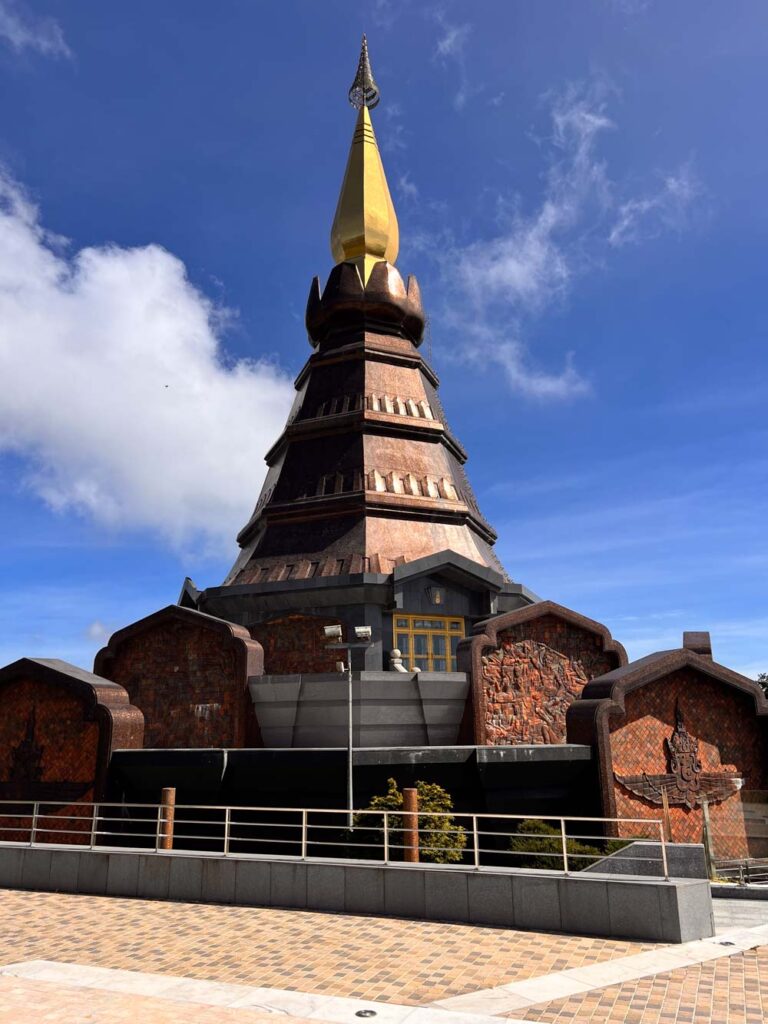
- The Queen’s Pagoda, Phra Mahathat Naphaphonphumisiri, is circular with seven tiers, said to reflect the seven colours of the rainbow, a symbol of peace and unity. The outside is covered in sparkling coloured glass mosaics and right at the top is a massive bronze bell that weighs over 7,000 kilograms.

Inside both, you’ll find murals that tell stories from the life of the Buddha, blending Thai spirituality with the country’s royal heritage.
We always try to understand the background of the places we visit and for us, this felt like more than just a photo stop. The symbolism, the setting, the atmosphere, it’s one of those places that stays with you.

💡 Planning a trip but not sure where to start? 🤔
👉 Grab your FREE Guide to 50+ of the BEST travel apps – Apps to help you navigate, find volunteer roles, house swapping, transport, planning, and more!
✈️ As full-time travel photographers, we’ve personally tested and used every app in this guide during our 18 months on the road, and they honestly made travel smoother, smarter, and way more fun.
📩Pop in your email and we’ll send it straight over – hope it helps make your next adventure a little easier!
Royal Pagoda Site Overview
The layout here is pretty simple once you arrive, but it’s still handy to know what to expect before you go.

👉The two Pagodas sit opposite each other, connected by gently sloping walkways, steps, and terraces. You’ll start at a central point and then choose which pagoda to visit first. We don’t think there’s a “right” order, so just wander as you like. You can see both from the entrance.

👉 There are escalators if you are unable to tackle the staircase but when we visited, they were out of service. If you’ve got limited mobility or you’re travelling with kids or older relatives, just be aware there are quite a few stairs, though the paths are wide and paved, so most people will be fine with a bit of steady walking.

👉 In front of the Pagodas, you’ll find gorgeous flower gardens with the odd fountain. They were bursting with colour when we visited in November.
👉There are also viewing terraces with big open panoramas of the valleys below. If the skies are clear, you can see for miles.

👉 There’s a small coffee shop and cafe near the drop-off point, which is great for a little break and a bite before heading back down. There are also benches to sit and wait for your shuttle back to the car park.
👉 Toilets are available on site near the entrance.

💡Parking Tip: A little heads-up: there’s no parking right at the Pagodas, but there’s a designated car park nearby with a free pick-up truck shuttle. If you’re self-driving, Google Maps will take you to the gated entrance, where security guards will redirect you.
Just head up the hill and you’ll see the car park on the right-hand side.
The shuttle runs between 8:00 AM and 4:00 PM and it’s just a short ride, but if you’re visiting outside those hours, be ready for a bit of a walk uphill.
We chose the walk and it’s further than it looks and kinda rough on the way back up in the heat! We were determined to hit our step count and were being too inpatient to wait for the shuttle, but we definitely had a few regrets watching it ferry past us more than once on the walk up.


What is the entrance fee for the Royal Twin Pagodas?
There are two separate fees to factor in when visiting the Royal Pagodas.
One for Doi Inthanon National Park and another for the Twin Pagodas themselves.
Doi Inthanon National Park fee
The current national park ticket price is:
- 300 baht per person for foreign visitors (around £6.95 or $8)
- 50 baht for Thai nationals
This covers access to the entire park for five days, including other spots like the other hikes in the park, the summit area and the waterfalls.
💡A quick note on pricing: The tourist vs local pricing often sparks debate among travellers. While we know some people may not like it, we’ve got no problem paying the tourist price. We’ve also seen people try to argue the fee, but the rates are fixed across the country, and staff at the entrance are simply doing their job. So just plan ahead and budget for it.
Royal Pagodas Entrance Fee
- 100 THB per person (on top of the park fee)
This one often catches people off guard, (including us) as the park doesn’t manage the Pagodas, so their fee is separate.
It’s cash only and they usually collect the Pagoda fee near the shuttle area or at the entrance checkpoint, so it’s best to have small notes on hand.

What are the Royal Pagodas opening Hours?
The Royal Pagodas (also known as the Two Chedis) are generally open during the same hours as the park, from 5:30 AM to 6:30 PM daily, all year round.
When Is the Best Time to Visit the Royal Pagodas?
Timing your visit can really shape your experience, not just for the views and photos, but also for the light, weather and how busy it feels.
Best season to visit
The dry season, from November to February, is ideal. You’ll get cooler temperatures, better visibility and the gardens are usually at their most colourful. We visited in November and had lovely blue skies and sunshine, which was perfect for exploring, though we did arrive a bit too late in the day to catch the softer light for photos.
Best Time of day to visit
Early morning is by far the best time to go. If you can make it up around sunrise, there’s a good chance of seeing the sea of clouds surrounding the valleys beneath you. The morning light creates this dreamy atmosphere that feels totally different to later in the day. We spent the morning at a waterfall and so arrived way too late, but it’s something we’d definitely plan for next time.
That early slot is also great for avoiding the crowds. It’s quieter, the light is more flattering for photography and you’ve got space to really enjoy the gardens and terraces.
Late afternoon can also be beautiful, especially for golden hour shots. Just bear in mind that the site closes at 5:00 PM, so you’ll want to give yourself plenty of time to explore.
Best Day To Visit
Try to go on a weekday if possible. Weekends and Thai holidays get busy, especially in peak season, as this place is popular with both Thai locals and tourists. We went midweek and even though we were expecting it to be super chaotic, being one of the more famous things to do in Doi Inthanon, it was a surprisingly calm and easy going visit with no queues or big tour groups.

📸 FREE Guide – 11 Simple Tips To Elevate Your Travel Photos
✅ Designed to help anyone take better travel photos, with no technical jargon, no confusing settings, and no need for fancy gear.
🎉 Simple, practical tips to take better photos – whether you’re using a camera or your phone!
How Long do you need to visit the twin pagodas?
We’d say give yourself at least an hour or two here, though you could easily spend up to three if the weather’s nice and you want to take your time with photos, the gardens and the viewpoints.
There’s more to see than you might expect. It’s not just a quick snap-and-go, there are two Pagodas to walk around, each with different architecture and details, plus landscaped flower gardens, viewing terraces and quiet little spots to sit and take it all in.
If you’re visiting during peak times, factor in a bit of time for the shuttle ride from the car park (especially if you’re waiting in line) and maybe a stop at the coffee shop or restaurant near the entrance.
For most people, 60–90 minutes is the sweet spot, which is enough time to enjoy the space, explore both Pagodas and not feel rushed. If you’re really into travel photography or want to soak it all in slowly, you could easily linger longer.

Things to See at the Royal Pagodas
There’s more to the Royal Pagodas than just the two main structures. If you take your time and look around properly, there’s actually quite a bit to enjoy while you’re here.
Explore both Pagodas
Each one has a completely different feel, the King’s pagoda is square and gold-accented, while the Queen’s is circular, with stunning coloured glass mosaics and a huge bronze bell at the top. Don’t just photograph the outside and move on, go inside, look at the murals and take in the details. Also, make sure you take a walk around the outside of the Pagodas, as the walls are so impressive to look at.


Walk through the gardens
The flower beds between the Pagodas are beautifully kept and often full of seasonal flowers. Great for a slow wander or just sitting with a coffee and enjoying the view.


Check out the viewing platforms
You’ll find several spots with open views across the valleys. On a clear day, you can see for miles and in the early mornings, you might catch that famous sea of clouds.


Visit the greenhouses
If you walk from the car park instead of taking the shuttle, you’ll pass a few smaller greenhouses along the way. They’re easy to miss but worth a peek, especially if you enjoy photographing flowers or just fancy a slower pace. This was actually one of our favourite sections as there was no one else around and there were tons of small details like ornaments and colourful benches to sit down on.

Pause for a quiet moment
The Royal Twin Pagodas are sacred spaces and there’s a lovely stillness to them. Whether you’re into Buddhist symbolism or just appreciate peaceful places, it’s worth taking a moment to pause inside or find a bench in the gardens and just take it all in.


Grab a coffee or light snack
There’s a little café near the entrance, nothing fancy, but good for a break if you’re spending more time here or waiting for the shuttle.
What to expect – Our Personal Experience
We visited the Royal Pagodas on a sunny November day during the dry season and honestly, it was one of the calmest and easiest stops on our Doi Inthanon trip.
Instead of taking the shuttle, we decided to walk up from the car park and yes, we arrived a bit hot and sweaty. But it was totally worth it.
Walking meant we passed through the greenhouses and gardens on the way, which most people on the shuttle would probably miss. It added a peaceful start to the visit and gave us a chance to enjoy the surroundings a bit more slowly.

There were a few other visitors around but it wasn’t too crowded. We went midweek, which definitely helped. We spent around 90 minutes wandering between the two Pagodas and never felt rushed.
The gardens were lovely. Full of colour, tidy paths and little benches where you could sit and take it all in. We found it pretty relaxing and even with a handful of tour groups passing through, it never felt hectic.
We loved the murals inside the Pagodas. The detail in the artwork was really impressive and well worth pausing to look at properly, especially if you’re into Buddhist art or cultural design.


We had blue skies and clear views all day, so no mist or clouds for us, but the light was a bit harsh by the time we arrived. We’d spent sunrise at a nearby waterfall, which meant we got here way too late in the day for photography.
I ended up just taking a few phone snaps for this blog.
Even though we didn’t visit at the right time of day for photography, we could see how the golden hour light would look beautiful on the Twin Pagodas and gardens. If you’re after soft, warm light for your photos, it’s definitely worth planning your timing around it.
What to Wear and Bring to the Twin Pagodas
- A reusable water bottle – we recommend Water-to-Go filter bottles, as they can be used almost anywhere and filter out viruses and bacteria. Keeping you hydrated, safe and reducing single-use plastics!
- Layers — It can be quite cool (around 10°C), especially in the morning or if clouds roll in. A light jacket or fleece is a good idea.
- Comfy shoes — You’ll end up walking more than you think, even if you take the shuttle. Trainers or walking shoes are ideal.
- Sun protection — Even when it’s cooler, the sun can be strong, so bring sunscreen, sunglasses and maybe a hat.
- Water and snacks — There’s a small café on site, but not loads of options nearby, so it’s worth having a bottle of water and a snack with you.
- Camera or phone — For obvious reasons. Even if you’re not aiming for golden hour shots, the gardens and views are still lovely.
- Cash — There are no ATMs in Doi Inthanon National Park and the Pagodas don’t accept cards, (as of 2024) so make sure you’ve got enough Thai baht with you for entry fees, food and anything else you might need.
- Something respectful to wear — The Pagodas are sacred spaces, so make sure to wear clothing that covers your shoulders and knees. It’s not super strictly enforced, but it’s always good to be respectful when visiting religious sites.

📸Outdoor photography comes with its own challenges!
Download our FREE photography planning guide below👇 packed with 8 simple location tips to help you capture breathtaking photos and ensure you don’t miss the golden hour!
7 Photography Tips for the Royal Pagodas
Even if you’re not a serious photographer, it’s hard not to be inspired here.
The symmetry, colours and sweeping views make the Royal Pagodas one of the most photogenic spots in Doi Inthanon if you get the right conditions.
We weren’t visiting as photographers this time, just taking it in and snapping a few shots on our phones but there’s definitely a lot of potential if you time it right.
And to be honest, looking back at our phone photos, we regret not taking our cameras with us.
Here are 7 tips if you’re keen to capture the best of it:
1. Early morning is your best friend
If you’re hoping for soft light and that magical atmosphere, aim to arrive around sunrise. When the conditions are right (usually dry season), the sea of clouds below the Pagodas creates a dreamy, diffused light that works beautifully for wider shots and moodier compositions.
2. Pay attention to the small details
The small details were my favourite thing to photograph on my phone. The flowers, the murals and the carvings are just as important as capturing the large structures and are far easier to shoot if you’re visiting during the day.

3. Afternoon Golden Hour
If you’re not an early bird, then an afternoon after 4pm will also work well. Just keep in mind the site closes at 5:00 PM, so plan ahead if you’re chasing golden hour light.
4. Lenses that work well
A wide-angle lens will help you capture the scale of the structures and the gardens, while a mid-range lens can help with more detailed shots of the murals, carvings, or the symmetry in the landscaping. Pack your travel photography kit wisely.

5. watch the light
If you’re visiting in full sun (middle of the day) like we were, the contrast can be pretty harsh, especially on the white and reflective surfaces. It’s still beautiful, just a little trickier for photos. So bring an ND filter.
6. Be mindful of quiet zones
Inside the Pagodas, try to keep things low-key and avoid using flash. These are sacred spaces and it’s worth taking a moment to soak it in without the lens too.
7. View from above
If you want a view of both Pagodas from higher up, creating that birds eye view composition, head to the Kew Mae Pan hiking trail early in the morning. Part of the hike looks down onto the both Pagodas and the surrounding gardens. And if you get there early in the dry season, then its likely you will have the beautiful sea of clouds below you, making for a perfect photograph.
❗NOTE: You can fly a drone at Doi Inthanon National Park if you have a drone license for Thailand. However, drones are not permitted at The Pagodas due to the altitude and ongoing military operations in the skies, so please leave your drone in your bag. For details on the required licenses and approvals, check out the Drone Travellers blog—they’ve got all the info on how to get started!

How to get To the Royal Pagodas from chiang mai
The Royal Twin Pagodas sit high up on Doi Inthanon mountain in Doi Inthanon National Park, around 100 kilometres southwest of Chiang Mai. It takes roughly 2 to 2.5 hours to get there, depending on traffic and how many photo or coffee stops you make along the way.
Despite not being in the city itself, they’re still considered one of the best things to do from Chiang Mai, especially if you’re keen on nature, photography or quiet cultural spots.
You’ve got three main options for getting there:
- Self-driving
- Joining a tour
- Attempting public transport
We’ll be honest, the third option isn’t great, but it is technically possible.

🚗 Option 1: Driving Yourself from Chiang Mai to the Royal Pagodas (Our Preferred Choice)
This is the option we chose and we absolutely recommend it if you like flexibility and exploring at your own pace. Hiring a car in Thailand gave us so much freedom.
We spent the early morning at a waterfall, then headed up to the Pagodas afterwards. It meant we could stop for snacks, take detours and arrive without any pressure from a set schedule.
Hiring a car is also ideal if you’re planning to combine the Royal Pagodas with other Doi Inthanon stops like Wachirathan Waterfall, Kew Mae Pan Trail, or the summit boardwalk.
🗺️ Directions from Chiang Mai:
- Head southwest from Chiang Mai on Highway 108
- At Chom Thong, turn onto Route 1009
- Go through the Doi Inthanon checkpoint and past the main visitor centre
- Continue up the road until you see signs for the Royal Pagodas car park
🤔 What to Expect on the Drive:
- The road is fully paved and in good condition
- It’s a steady uphill climb with a few curves, but nothing too difficult
- Parking is free near the Royal Pagodas and we easily found a spot midweek
- A free shuttle truck runs from the car park to the pagoda entrance (8:00 AM – 4:00 PM), or you can walk up like we did — it’s a bit steep, but peaceful
💡TIP: We hired a car through Booking.com for almost three weeks and had a great experience! The booking process was simple, and the pickup was smooth. If you’re thinking of doing the same, make sure you bring an International Driver’s Licence, which you’ll need to rent and drive legally in Thailand. You can apply for this in your home country before your trip.

‼️Important note about motorbike hire in Thailand
Although you are legally allowed to hire motorbikes in Thailand on a standard car driving licence, unless you have a motorbike licence in your home country, we do NOT recommend motorbike hire.
I know that this is a very sticky subject and many blogs will tell you how great and affordable motorbike hire is in Thailand as a way to travel.
BUT, we researched this thoroughly before travelling to Thailand and found that from an insurance and legal perspective, if you do not have a motorbike licence in your home country and you have an accident, then your insurance company will not cover you. And you may be in breach of Thai law if someone is injured.
‼️An international driver’s permit will satisfy bike hire companies and police at checkpoints, but in the event of an accident, it is not enough as an IDP is not a standalone licence and is used alongside your national licence.
So, ensure you research this thoroughly before deciding on bike hire to check up-to-date laws and regulations.
The number of motorbike accidents in Thailand is one of the highest in the world, so having experience and the correct licence is essential for your safety.
💡TIP: We use SafetyWing Nomad Insurance and have no hesitation in recommending them for your travels. We have had personal experience of filing a claim and dealing with them as an organisation. We found the claims process straightforward, and the payout was very quick!
🚐 Option 2: Booking a Tour from Chiang Mai (Easiest)
If you don’t fancy driving, booking a private or small-group tour is a really easy way to visit the Royal Pagodas. It’s probably the best choice if you’re short on time and just want to enjoy the day without worrying about logistics.
Most tours to Doi Inthanon include the Royal Pagodas, waterfalls, viewpoints and often a short nature trail too.
💰 What’s Usually Included:
- Return transport from your accommodation in Chiang Mai
- Entry to Doi Inthanon National Park (check if this is included)
- Stops at the Royal Pagodas and other scenic places
- A local guide, lunch and drinking water
✅ Pros:
- No driving or navigation needed
- Great if you’re limited on time but still want to see the highlights
- Usually covers a full day of sights
- Free cancellation is often available and no payment in advance for added flexibility
❌ Cons:
- Timings are fixed, so you’ll miss sunrise or golden hour
- Some stops can feel a bit rushed, especially in high season
- Less freedom to explore at your own pace
💡When booking a tour, we use Seek Sophie, Get Your Guide and Viator as they offer free cancellation making it easy to book activities with no pressure or problems if your plan changes!

✅ Recommended Tours
We know how tiring it can be to sift through endless options only to find they’re not quite right!
To make things easier, we’ve highlighted four well-rated day tours from Chiang Mai to The Royal Pagodas below that include different stops depending on your travel style AND our top pick booked through our favourite tour company, Seek Sophie 👇
🌿🚌 Most Unique Tour 👇
2D1N Ethical Elephant Observation with Doi Inthanon Hike & Night Under the Stars
- Free cancellation – cancel up to 7 days in advance for a full refund
- Ethical and sustainable option directly benefitting the community
- 2 days 1 Night
- English speaking guide
- Pick up and drop off from Chiang Mai included
👉Itinerary and what you will see
- Hike the stunning Pha Dok Sieo Nature Trail in Doi Inthanon National Park, with waterfall and rice field views
- Visit the beautiful King and Queen Pagodas and take in panoramic mountain views
- Spend the night at a peaceful hut with a traditional Northern Thai dinner and campfire under the stars
- Experience a truly ethical morning trek alongside free-roaming elephants — no rides, no touching, no feeding
Other Options from Chiang Mai 👇
- 🥾🌿🛕 Doi Inthanon National Park, Royal Pagodas and hike at Kew Mae Pan Nature Trail (A popular hike that includes a birds-eye view of The Royal Pagodas)
- 🥾🌿🛕 Doi Inthanon National Park, Royal Pagodas and hike at Pha Dok Siew Nature Trail (Our favourite hike in the park – choose this one if you love long hikes)
- 🥾🌿 🛕 Doi Inthanon National Park, Royal Pagodas and hike at Ang Ka Nature Trail (An easy boardwalk through a cloud forest)
📸 Tip: If photography is a priority, check that the tour departs early enough to catch soft morning light. If not, then you should consider booking a private tour.

‼️‼️Important Note: You will see elephant tours advertised A LOT in Thailand.
Please ensure you are booking with a truly ethical sanctuary where they are completely hands-off.
🐘This means No bathing – No touching – and No feeding.🐘
A truly ethical sanctuary is 100% hands-off and encourages natural elephant behaviours.
🐘 You can learn how to choose an ethical elephant sanctuary in Thailand here.
📍 In Chiang Mai? We recommend Chang Chill Sanctuary, an hour from Chiang Mai, which is the sanctuary that we chose to visit.
📍In Bangkok or Kanchanaburi? We recommend Somboon Legacy Foundation just a few hours from Bangkok, where we volunteered for a month.
🚌The only tour company we recommend for elephant tours is Seek Sophie as they are pioneers for responsible and ethical travel.
📚Please see The Call to Conserve website for a list of an up-to-date list of ethical elephant facilities in Asia.
Note: We will never recommend any tours involving animals unless we have been on these ourselves or have assurances from conservationists that they are ethical facilities.
🛺 Option 3: Public Transport from Chiang Mai (Budget-Friendly, But Tricky)
It’s technically possible to get to Doi Inthanon National Park using public transport, but we wouldn’t recommend it for visiting the Royal Pagodas specifically. The distances inside the park are long and not walkable and public transport doesn’t go all the way up to the pagoda car park.
Here’s how it works:
- Take a songthaew (shared red truck) from Pratu Chiang Mai Market to Chom Thong
- Transfer to another local songthaew going up Route 1009 into the park
- You’ll likely be dropped off near the checkpoint or visitor centre, but not at the Pagodas themselves.
From there, your options are:
- Hitch a ride with other travellers (which isn’t guaranteed)
- Hire a local driver if one is available
- Walk several kilometres uphill along the road
❌ Why It’s Not Ideal:
- Takes 3+ hours and depends on unpredictable connections
- No early start possible, so you miss the best light
- Hard to reach multiple sights without your own transport
- You’ll likely be relying on luck or local help for the final stretch
Another option is to hire a Grab or private driver for the day, though this could end up costing more than joining a guided tour.

✅The option we recommend
We’ve done public transport and self-driving in Thailand and for this trip, self-driving really is the winner.
It gave us the freedom to stop where we liked, explore at our own pace and not stress about missing any of the views.
If that’s not an option, a small-group or private tour is a solid backup.
Just double-check that the Royal Pagodas are included, as some Doi Inthanon itineraries focus only on the waterfalls and summit trails.
Things to do nearby in doi inthanon
If you’re already heading up to the Royal Pagodas, we’d definitely recommend turning your trip into a full day. Doi Inthanon has a lot more to offer than just the famous twin structures. Whether you’re into waterfalls, nature trails, or mountaintop viewpoints, there’s something for every kind of traveller.
Here are a few of the best things to do nearby:
Wachirathan waterfall
One of the most well-known waterfalls in the park and really easy to reach. It’s powerful, photogenic and there’s a short path leading to a great viewing area. Expect to get wet if you get close, which feels pretty refreshing on a hot day but not ideal for your camera!

Kew mae pan nature trail
A short but rewarding ridge trail with stunning panoramic views. You’ll need to hire a local Hmong guide, which you can do at the trailhead. Kew Mae Pan trail is well maintained and relatively easy. It’s especially beautiful early in the day. Just a note, it’s closed from June to October for forest recovery.

Mae klang waterfall
Often overlooked because it’s right near the entrance to the National Park, but it’s actually a great first or last stop. Mae Klang is a lovely multi-tiered fall with several levels to explore. It’s also close to the car park, so you don’t need to hike far. There are a few food stalls nearby too if you’re hungry on the way in or out.

Doi Inthanon summit
The highest point in Thailand. There’s not a huge viewpoint at the top, but it’s still a cool stop and you can have a photo with the famous sign, which shows just how cold it is up there.

Ang ka nature trail
Just an 8-minute drive from the twin pagodas, this is a gentle boardwalk trail through a lush, moss-covered cloud forest. It’s only about 360 metres long and can be completed in 20 minutes, but it’s incredibly atmospheric. Ang Ka is a great option to pair with the twin pagodas due to its close proximity and short distance.

Pha dok siew nature trail
A peaceful, mostly downhill trail that takes you past a series of waterfalls, rice terraces and ends in a local Karen village. This was our favourite hike. It’s a slower, more immersive way to experience the landscape. You’ll need to go with a local guide, which you can arrange at the trailhead.

mae ya waterfall
Further out, but worth the extra time if you’re keen on waterfalls. Mae Ya is wide, dramatic and set in a quiet forested area. It’s a great spot for late afternoon if you’re heading back toward Chiang Mai. Our favourite waterfall in the park and also one of the most spectacular we’ve ever visited.

Sirithan waterfall
One of the easiest waterfalls to visit and an easy 20-minute stop off if you have some time to kill. Framed by trees and viewed from a wooden platform in the middle of a forest, Sirithan is super different to any of the other falls in the park.

Are the royal pagodas worth visiting?
If you’re already heading to Doi Inthanon, we’d say yes, the Royal Pagodas are absolutely worth a stop.
They’re beautiful, peaceful and offer something a little different from the waterfalls and trails that most people focus on.
Even though we arrived later in the day and didn’t get the best light for photography, we still really enjoyed the visit.
It’s not a hidden spot and you’ll likely see a few tour groups, but it doesn’t feel overly commercial either. If you visit on a weekday or early in the morning, it’s genuinely peaceful and the cooler mountain air makes it a refreshing break from the hot stuffy city.

That said, if you’re a photographer or nature-lover on a tight itinerary and your priority is chasing dramatic waterfalls or hiking trails, then you might choose to skip the Pagodas and spend more time at places like Mae Ya or Pha Dok Siew instead.
The Pagodas are pretty cool, but they don’t quite offer the same wild, natural feel as some of the other stops in the park.
We’d especially recommend the Royal Twin Pagodas for:
- Travellers curious about Thai history or Buddhism
- Garden and architecture lovers
- Anyone after a quiet, reflective stop that doesn’t involve hiking
It won’t take up your whole itinerary, but it adds a really lovely contrast to the more active parts of the park.

FAQs About Visiting the Royal Pagodas
Does the Royal Pagodas have a dress code?
We didn’t see signs explicitly stating this or see it enforced but this is a sacred space it’s a good idea to wear clothing that covers your shoulders and knees. Even though its not a strict rule, being respectful is always appreciated. Think of it the same way you would when visiting a temple or shrine elsewhere in Thailand.
What is the purpose of the twin pagodas?
The Pagodas were built to honour the 60th birthdays of King Bhumibol and Queen Sirikit and are meant to symbolise their spiritual and environmental leadership. They blend Buddhist themes with royal Thai values, so visiting is both a cultural and historical experience.
Are the Royal Twin Pagodas open all year?
Yes, they’re open year-round. The best time to visit is during the dry season (November to February) when the skies are clear and the gardens are in full bloom.
Can i visit the Royal Pagodas without a tour?
Absolutely. We drove ourselves and found it straightforward, but there are also plenty of guided tours that include the Pagodas if you’d prefer someone else to handle the planning.

Are there toilets and place to eat nearby?
Yes, there’s a small café and restaurant close to the entrance and toilets on site. Don’t expect anything fancy, but it’s enough for a snack and a quick rest.
Can I fly a drone at the royal pagoadas?
Flying a drone is not allowed at the Royal Pagodas due to ongoing military operations in the skies, so please leave your drone in your bag.
How much time do I need at the royal pagodas?
We’d suggest at least an hour, ideally 90 minutes, especially if you want time for photos, walking through the gardens and just slowing down a bit. If you’re in a rush, you could see the main highlights in less, but it’s much nicer without clock-watching.
Where to go next in northern thailand
We loved our time in Chiang Mai and hiking through Doi Inthanon National Park, but honestly, that’s just the beginning. Northern Thailand has so much more to offer and some of our favourite places were the quiet, under-the-radar spots that most travellers never even hear about.
We spent three weeks exploring the region and came across some real gems. Places with epic landscapes, rich local culture and a kind of calm that’s hard to find once you’re on the main tourist trail.
If you’ve got a few extra days, here are a few spots we’d really recommend:
Doi Mae salong
Rolling green hills, misty mornings and endless tea plantations, this peaceful hilltop town feels completely different to the rest of Thailand. Mae Salong has a strong Chinese heritage,and incredible mountain views.

Phu Chi Fa
If sunrise is your thing, this is one of the best we’ve ever experienced. You hike up in the dark and watch the sun rise over a thick sea of clouds spilling across the Laos border. It’s dramatic, quiet and absolutely worth the early alarm. Phu Chi Fa is just an hour or so from Chiang Rai.

Lampang
Hardly anyone seems to go here, but it’s 100% worth it. It’s home to Wat Chaloem Phra Kiat, also known as the Sky Temple. It’s a series of white Pagodas perched on jagged mountaintops. It’s one of the most unique temples we’ve ever visited and a total dream for photography.

Heading back towards Bangkok?
Don’t miss beautiful Kanchanaburi with its peaceful temples, interesting history, ethical elephant sanctuary and clear blue waterfalls!
Plus, you can take a really cool train journey to get there from Bangkok.
More Thailand Inspiration!
- Visiting Phu Chi Fa Mountains in Thailand – A Photographers Guide
- 2-Week Northern Thailand Itinerary for Photographers
- How to get from Chiang Mai to Doi Inthanon National Park
- Guide to Ang Ka Nature Trail in Doi Inthanon National Park
- Pha Dok Siew Nature Trail – Doi Inthanon National Park
- How to choose an ethical elephant sanctuary in Thailand
- Kew Mae Pan Nature Trail in Doi Inthanon National Park
- Mae Ya Waterfall in Doi Inthanon National Park – A Photographers Guide
- Mae Klang Waterfall in Doi Inthanon National Park – A Complete Guide
- Mae Salong in North Thailand – A 2-Day Itinerary
- Things to do in Doi Inthanon – A Day trip from Chiang Mai
- The Overnight Sleeper Train from Bangkok to Chiang Mai
- How to Visit Thailand’s Sky Temple in Lampang
- How to Travel from Chiang Mai to Bangkok by Day Train
- Ultimate Guide to Wat Sam Phran Dragon Temple in Bangkok
- Visitors Guide To Sirithan Waterfall in Doi Inthanon
- Wachirathan Waterfall in Doi Inthanon – A Complete Guide
- 4 Beautiful Doi Inthanon waterfalls You Shouldn’t Miss
- A Complete Guide to 3 Beautiful Doi Inthanon Hikes
- A Complete Guide to Twin Royal Pagodas at Doi Inthanon
- Chang Chill – An Ethical Elephant Sanctuary in Chiang Mai
- Is It Safe to Drive in Thailand? Everything You Need to Know
- Chiang Mai Lantern Festival: Is it Worth it? An Honest Guide
- 11 Best Places to Visit in Northern Thailand for Photography
- 4 Day Chiang Mai Itinerary for Photographers
- Guide to The Tiger Cave Temple in Kanchanaburi – Wat Tham Sua
- The Photographer’s Guide to Erawan Waterfalls, Kanchanaburi
Tips to elevate your photography
- Mastering What Shutter Speed to Use for Perfect Shots
- Must Have Travel Photography Gear for Your Next Adventure
- How To Find Photography Spots: A Travel Photographers Guide
- When is the Best Time to Take Pictures Outside?
- Best Lens for Travel Photography: What to Pack and Why
- 17 Photography Composition Techniques for Top Travel Photos
- Understanding Aperture: Examples & Photos for Beginners
- Practical Tips to Elevate Your Photography on a Cloudy Day
- 21 Tips for Photographing Mountains
- Ultimate Guide to Perfecting Waterfall Photography
- What is Travel Photography? Start your adventure today!
- 11 Types of Travel Photography Every Traveller Should Explore
- 16 Game-Changing Tips on Travel Photography
- Beginners Guide To Photographing People While Travelling
