
Guide to The Tiger Cave Temple in Kanchanaburi – Wat Tham Sua
InWanderment contains affiliate links. If you make a purchase or a booking using these links, we may receive a commission at no extra cost to you. This helps with the cost of running InWanderment. See our Privacy Policy page for more information. We appreciate your support!
Tiger Cave Temple in Kanchanaburi is one of the most iconic places to visit in the region, but if you’re planning a trip with photography in mind, you’ll quickly realise there’s not a lot of practical advice out there.
Unlike temples in southern Thailand or Bangkok, there’s very little online that shows how to photograph it, what gear to bring, or even what the light’s like.
Being a little way out of the centre, it’s not very well known and there’s not much public transport nearby, so it’s easy to wonder: is it actually worth the effort?
We promise you that it is.
Perched dramatically on a hilltop, with panoramic views over bright green rice fields and the Mae Klong River, Wat Tham Sua in Kanchanaburi is an incredible spot for landscape and drone photography.
The golden Buddha is huge and beautifully detailed, the surrounding chedis are full of character and the lack of heavy crowds means you’ve got space to take your time, a rare luxury at temples in Thailand.
Most temple guides skip what really matters to photographers, what there is to photograph, how to frame the best angles and the best time to avoid crowds
We spent three hours here, climbing, photographing, resting and just soaking in the view and we’ve pulled together everything we wish we’d known beforehand.
From how to get there and what to wear, to entrance tips, the best time to visit, and exactly where to shoot, this guide will help you plan your visit and make the most of your time at one of Kanchanaburi’s most photogenic temples.
If you’re planning a photography-focused trip to Tiger Cave Temple in Kanchanaburi, this is the guide we wish we had.

Why Wat Tham Sua is a Dream for Photographers
Wat Tham Sua, also known as the Tiger Cave Temple and also Wat Tham Seua, is one of the most iconic temples in Kanchanaburi. The name comes from a small cave within the complex where a tiger is said to have once lived – “tham sua” translates directly to “tiger cave” in Thai.
It’s located in the Tha Muang district, about 20km (or around 25 minutes) from Kanchanaburi town, set high on a hilltop with panoramic views over rice fields and the Mae Klong River.
What makes it special and so striking for photography is the combination of features: a towering 18-metre-high golden Buddha, a dramatic staircase leading up to the temple, intricate Thai-Chinese architecture and an atmosphere that feels far more peaceful than many temples in the south.
💡 Planning a trip but not sure where to start? 🤔
👉 Grab your FREE Guide to 50+ of the BEST travel apps – Apps to help you navigate, find volunteer roles, house swapping, transport, planning, and more!
✈️ As full-time travel photographers, we’ve personally tested and used every app in this guide during our 18 months on the road, and they honestly made travel smoother, smarter, and way more fun.
📩Pop in your email and we’ll send it straight over – hope it helps make your next adventure a little easier!

Entrance Fees and Opening Hours for wat tham sua
Is there an entrance fee to Wat Tham Sua (Tiger Cave Temple)?
No, there’s no official entrance fee to Wat Tham Sua in Kanchanaburi, but donations are very much encouraged.
You’ll find a donation box near the top of the staircase and we always like to leave something as a small thank you. It’s a peaceful, well-kept site and supporting local temples helps keep it that way. Make sure to bring a bit of cash with you.
Is the cable car at Wat Tham Sua still running?
We didn’t see a working cable car during our visit just the track running up the side of the hill. Some older guides still mention it, but it seems like it’s either out of service or no longer operating.
So if you’re planning your visit, assume you’ll be walking the steps to the top.
What are the opening hours for Tiger Cave Temple in Kanchanaburi?
The temple is open every day from 8:00 AM to 5:00 PM. We went in the late afternoon and would really recommend it as after 3:00 PM the heat starts to ease off, the light softens (ideal for photography) and the crowds thin out.
We felt like we had the place to ourselves more than once. Early morning is another great option if you prefer cooler temperatures and that quiet, golden hour glow.

How to Get to Wat Tham Sua from Kanchanaburi?
Wat Tham Sua (Tiger Cave Temple) is located about 24 minutes from Kanchanaburi town and while it’s close enough for a quick visit, getting there does take a bit of planning, especially if you want to arrive early for the best light.
Can you drive to Wat Tham Sua yourself?
Yes, and it’s honestly one of the easiest and most flexible ways to visit. We hired a car during our time in Kanchanaburi, it made getting to the temple and other nearby spots like Erawan Falls and the Death Railway Line really simple.
Driving in Thailand felt very safe and we’ve rented cars for over a month during different trips around the country. It’s always been straightforward.
Just make sure you’ve got an International Driving Permit (IDP), as this is legally required to drive in Thailand.
There’s a huge car park at the base of the temple with loads of space and we had no trouble finding a spot.
We’d highly recommend booking through Booking.com as they compare the best deals and the platform is easy to use.
Since Kanchanaburi is slightly more remote, you would need to hire a car from Bangkok for the best price but if you’d rather hire in Kanchanaburi, this is the company we used.
🚗Hiring through Booking.com was a simple experience. There was a minimal deposit of £250 (no credit card required) and free cancellation until the day before we collected the car. We could also extend the hire via WhatsApp, which would have been helpful. I am always cautious about who we hire a car from after hearing one too many horror stories and having an anxious mind, but we found this to be a stress-free hire!

Should you hire a motorbike to get to Wat Tham Sua?
We don’t recommend hiring a motorbike unless you already hold a motorbike licence in your home country. Even though rental shops might let you hire one with just an IDP, it’s technically illegal to ride a bike in Thailand without the correct license and if you have an accident, your insurance likely won’t cover you.
The risks just aren’t worth it unless you’re fully licensed.
Can you take a Grab to Wat Tham Sua?
Grab (Asia’s version of Uber) does operate in Kanchanaburi and it’s a convenient way to get to the temple from town.
However, getting a return ride can be trickier, especially since Wat Tham Sua is in a more rural area. If you do use Grab, we suggest either asking your driver to wait or agreeing on a time for them to pick you up later.
Don’t rely on being able to book a return on the spot, especially in quieter hours.
💡TIP: We use SafetyWing Nomad Insurance and have no hesitation in recommending them for your travels. We have had personal experience of filing a claim and dealing with them as an organisation. We found the claims process straightforward, and the payout was very quick!
Is there a bus to Wat Tham Sua from Kanchanaburi?
There are local buses and songthaews that run from Kanchanaburi town towards the Tha Muang district, where the temple is located. But if you’re aiming to arrive in time for soft morning light or to avoid the afternoon heat, the timing can be a bit hit-and-miss.
Public transport here isn’t always geared toward sightseeing, you might find it hard to get back in the afternoon without a long wait.

Can you visit Wat Tham Sua in Kanchanaburi on a tour from Bangkok?
Yes, and this can be a great option if you’re short on time or want to see multiple sites in one day.
Some Bangkok-based tours include Erawan Falls and the Bridge over the River Kwai with an option to add in Wat Tham Sua, but our recommendation is a private tour or private driver so you have the flexibility to plan your own route.
🚌Recommended Tour
Most Kanchanaburi tours tend to include Erawan Falls and the more commonly visited Death Railway, so if you want to include The Tiger Cave Temple, you need to book a private tour so you can tailor your own itinerary.
👉 Private Tour: Best for photographers – Bangkok: Private & Customized Kanchanaburi Tour
‼️‼️Important Note: You will see elephant tours advertised A LOT in Thailand.
Please ensure you are booking with a truly ethical sanctuary where they are completely hands-off.
🐘This means No bathing – No touching – and No feeding.🐘
A truly ethical sanctuary is 100% hands-off and encourages natural elephant behaviours.
🐘 You can learn how to choose an ethical elephant sanctuary in Thailand here.
📍 In Chiang Mai? We recommend Chang Chill Sanctuary, an hour from Chiang Mai, which is the sanctuary that we chose to visit.
📍In Bangkok or Kanchanaburi? We recommend Somboon Legacy Foundation just a few hours from Bangkok, where we volunteered for a month.
🚌The only tour company we recommend for elephant tours is Seek Sophie as they are pioneers for responsible and ethical travel.
📚Please see The Call to Conserve website for a list of an up-to-date list of ethical elephant facilities in Asia.
Note: We will never recommend any tours involving animals unless we have been on these ourselves or have assurances from conservationists that they are ethical facilities.

🚂 Still not sure how to get to Kanchanaburi from Bangkok? We recommend catching the train from Thon Buri Station. It’s affordable and one of the prettiest train journeys we’ve travelled on!
How much time do you need at Wat Tham Sua to capture those perfect shots?
You’ll want to allow around 2 to 3 hours for your visit to Tiger Cave Temple in Kanchanaburi. The climb itself is interesting as the brightly coloured steps are beautiful and the view from the top is stunning.
Once at the top, there’s plenty to photograph from the golden Buddha to the panoramic views over the rice fields.
If you’re into travel photography, give yourself time to explore different angles, wait for the light to shift and maybe even fly a drone if conditions allow.
We spent about three hours here and felt that gave us the right balance of time to shoot, rest and enjoy the space without rushing.
Improve Your Photos!
✨ FREE 11 Simple Tips To Elevate Your Travel Photos ✨
Simple, practical tips to take better travel photos – whether you’re using a camera or your phone!
👉 No confusing camera speak, no settings to mess around with, just easy tips you can use straight away 👈

What to Expect at Tiger Cave Temple in Kanchanaburi
First impressions
The first thing you see is the bright staircase sweeping up the hillside. Many guides mention a climb of more than one thousand steps, but that figure belongs either to the similarly named temple in southern Thailand or to neighbouring Wat Wat Baan Tham
We counted fewer than 100 steps here. It is a quick ascent rather than a mountain workout.

No cable car in sight
Some websites still list a cable car to the top. We found only the old track and no sign of a carriage or ticket booth. Recent reviews echo our experience, so plan to walk the stairs.
Thai Chinese architecture and sacred details
At the top, the space opens out into a courtyard of Thai Chinese buildings, gilded statues and small shaded benches.
Mirrors and bright decorations hang from the trees and little shrines dot the edges. The centrepiece is a huge seated Buddha, the largest in Kanchanaburi, flanked by ornate chedis.
When we visited, the Buddha was under renovation, yet local worshippers still came to pay respects and the scaffolding did not spoil the atmosphere.


Exploring the towers
Several towers are open to visitors and you can wander inside without crowds. I had one tower entirely to myself while Steffan worked on compositions outside and it felt pretty magical.
Each window frames a Buddha image and the upper levels give a sweeping view across green rice fields and the Mae Klong River. A welcome breeze drifts through the arches, perfect for a breather after the climb.


Peaceful vibes if you time it right
We arrived around 4 pm and shared the complex with only a handful of locals. There were no vendors, no ticket staff and no tour groups. Compared with temples in Bangkok this felt almost private. The quiet makes it easier to set up a tripod, fly a drone or wait for changing light without interruption.


Is the climb worth it?
Absolutely. The short staircase is gentle, the viewpoint is spectacular and the mixed Thai Chinese design offers something different from the classic temple in Kanchanaburi. If you enjoy photography, architecture or simply a calm place to sit and take it all in, Tiger Cave Temple is a real gem.


Short Video of our trip to Tiger Cave Temple, Kanchanaburi
We filmed a short video at Tiger Cave Temple in Kanchanaburi to give you a quick look at what to expect. It was shot on my Sony RX100, which has a handy 200mm zoom, great for capturing detail from a distance.
It’s a good way to see the layout and atmosphere before you visit.

9 Things to See and Photograph at the Top of Wat Tham Sua
Once you reach the top of Tiger Cave Temple in Kanchanaburi, the space opens up into one of the most rewarding photography spots in the region.
From sweeping views to tiny details, here are the key things to look out for and how to photograph them.
👉 Wide angle lens to capture the whole scene and landscapes from the top
👉Zoom lens to capture those details
👉A drone to get some arial shots of the complex
1. The staircase and temple from below
Before you head up, take a moment at the base of the steps. The brightly coloured staircase curves dramatically up the hill and makes for a great wide-angle shot. Position yourself centrally and frame upwards to show the scale.
It’s also an ideal place to fly your drone for a sweeping overhead image of the staircase and temple nestled in the hillside.


✨ Share your photos in my Travel Photography Facebook group! ✨
2. The Buddha (Chin Prathanporn)
The giant seated Buddha is the centrepiece of the temple and the largest in Kanchanaburi. It was under construction during our visit, but still drew locals coming to pay respects.
If you’re lucky enough to catch it without scaffolding, it makes a striking subject from multiple angles, especially framed through archways or with visitors at the base to show scale. This is one of the photos we were really hoping for but maybe next time.

3. Chinese-inspired temple buildings
The surrounding buildings have a unique Chinese influence, with pointed rooftops, layered tiers and bright colours. While they don’t have official names that we could find, they photograph beautifully. Use a zoom lens to capture the intricate carvings and architectural detail, or shoot wide to show the symmetry and layout of the space.


4. The golden chedi (Ketkaew Prasat Chedi)
One of the most ornate parts of the complex, this golden tower is full of intricate details both inside and out. Head inside to explore its winding interior.
It’s dimly lit but peaceful, with soft natural light coming through the windows. It’s a great spot to slow down and experiment with contrast and moodier shots.


5. Archways and symmetry shots
The temple’s architecture is full of repeating shapes and layered archways, which is perfect for creating symmetry in your compositions.
Look for leading lines and use the arches to frame subjects or guide the viewer’s eye. It’s a great place to play with balance and depth, especially in the corridors and stairways.


6. Buddha statues inside the towers
Inside the tallest tower, we found a Buddha statue in every window along the upper level. It felt surreal and quiet and I had the whole place to myself.
It’s a little dark inside, so you may need to bump up your ISO. Reflections on the tiled floors add another layer if you shoot low and carefully watch the light.


7. The viewpoint over rice fields and the Mae Klong River
From the edges of the upper platform, you’ll get wide-open views across the countryside. It’s one of the best places in the area to capture Kanchanaburi’s landscape from above.
A wide lens works well here, especially in the late afternoon when the light softens and the colours in the fields really come alive. It even looks beautiful on a cloudy day, so don’t worry if it’s overcast when you visit.


8. Small details and storytelling elements
Look closely and you’ll notice mirrors strung in the trees, colourful ribbons wrapped around statues, faded murals and small offerings in corners. These are the kinds of details that help tell the full story of the temple. They’re perfect for tighter shots or as part of a set if you’re putting together a blog or gallery as part of your travel photography portfolio.


9. People worshipping – shoot respectfully
We saw very few tourists here, mostly locals visiting quietly. If you’re photographing people, be considerate. Avoid showing faces without permission and never interrupt someone who’s praying or making an offering. Capturing the presence of worshippers can add depth to your photos, but it’s important to do it mindfully.

📸FREE Photography Guide
Want to take your photography skills to the next level?
Download our FREE photography planning guide! It’s packed with 8 simple location tips to help you capture breathtaking photos, no matter your skill level.
Simply enter your details below, and we’ll send you the guide along with additional tips and tricks to inspire your photography journey. Whether you’re a beginner or looking to refine your craft, this guide will set you up for success.
Download our FREE guide below👇
Flying Your Drone at Wat Tham Sua (Tiger Cave Temple)
Can you fly a drone at Tiger Cave Temple in Kanchanaburi?
When we visited, there were no signs prohibiting drone use at Wat Tham Sua, which is a good sign as in Thailand, drone bans are usually clearly marked.
That said, you’ll still need to make sure you’re properly licensed to fly a drone in Thailand.
If you’re unsure what’s required, check out the drone traveller’s guide on how to get your drone licence sorted before your trip.
We had no issues flying here and didn’t encounter any staff or locals questioning it, but it’s important to stay respectful. This is still a place of worship and the sound of a drone can easily ruin the peaceful atmosphere.

Best time and place to fly
The best time to fly is either early in the morning or late in the afternoon, when the light is soft and the shadows are long, perfect for showing off the temple’s location and structure against the rice fields below.
We recommend flying from the car park, just before the stairs start. It’s a spacious, open area with plenty of room to take off and land safely and it keeps the noise well away from people praying or exploring the temple.
It also gives you a clear line of sight to frame the temple from above without flying directly over anyone.
From the air, you can really appreciate the temple’s layout. The sweeping staircase, the golden Buddha and the layered rooftops all surrounded by open countryside. It’s easily one of the best drone photography spots in Kanchanaburi.

What to Wear and Temple Etiquette at Wat Tham Sua
What should you wear to Tiger Cave Temple in Kanchanaburi?
As with any temple in Thailand, you’ll need to dress modestly when visiting Wat Tham Sua. That means keeping your outfit respectful and temple-appropriate.
Here’s what to wear:
- Cover your shoulders – T-shirts, long-sleeve tops or a light scarf work well
- Cover your knees – Long skirts, trousers, or loose culottes are ideal
- Wear shoes that are easy to slip off – You’ll need to take them off when entering any temple buildings
- Bring a sarong or light cover-up – We didn’t see any rental options during our visit, so it’s best to come prepared, just in case
- If you’re unsure about whether to remove your shoes, the safest rule is: take them off whenever entering an indoor or sacred space. It’s a normal part of Thai culture and always appreciated.

Respectful behaviour inside the temple grounds
Wat Tham Sua is a peaceful, spiritual place and keeping that atmosphere intact is part of being a responsible visitor. These tips apply not just here, but to temples across Thailand and even more widely in places like Laos and Cambodia.
- Keep your voice low – people may be praying or meditating, it’s important not to disturb them
- Remove your shoes before stepping inside any temple or shrine building
- Don’t point your feet at Buddha statues – when sitting, try to kneel or tuck your feet behind you
- Be considerate when taking photos – avoid photographing people in prayer or monks without permission
As travel photographers, we’re often drawn to moments of quiet connection or worship, but we always pause to ask ourselves: is this the right time to take a photo? Sometimes the answer is no and that’s okay.

What is the History of Wat Tham Sua
Even though it looks ancient from afar, Wat Tham Sua is actually pretty modern. It was built in the early 1970s and the massive golden Buddha, the one you can see from miles away, was added in 1973.
The temple sits on top of a limestone hill with panoramic views over the Mae Klong River and the rice fields below, but what makes it really stand out is its mix of architectural styles. You’ll see a blend of Thai and Chinese design and the rich colours and ornate little details make it a dream to photograph.
And if you’re wondering about the name – “Tiger Cave Temple” – it comes from a small cave at the bottom of the hill. Local stories say tigers used to live there or left paw prints behind. Monks once meditated inside the cave, but it’s closed to the public now. Still, the name stuck and it gives the place just that little extra edge of mystery.

Are there tigers at Tiger Cave Temple in Kanchanaburi?
No, despite the name, there are no tigers at Wat Tham Sua. The name comes from a small cave at the base of the hill where tigers were once believed to live, or where fossilised paw prints were found. That’s where the “tiger cave” part of the name comes from – but you won’t see any live animals here.
You may come across other so-called “tiger temples” in Thailand that offer close-up encounters or photo ops with tigers. We don’t recommend visiting these kinds of attractions. They’re extremely unethical, with poor welfare conditions and questionable breeding programmes.
Wat Tham Sua is all about the views, the architecture and the peaceful atmosphere – no animals involved and it’s better for it.
📸 FREE Guide – 11 Simple Tips To Elevate Your Travel Photos
✅ Designed to help anyone take better travel photos, with no technical jargon, no confusing settings, and no need for fancy gear.
🎉 Simple, practical tips to take better photos – whether you’re using a camera or your phone!
What Else Is There to Do in Kanchanaburi?
If you’re planning your Kanchanaburi itinerary, you’ll be spoilt for choice. This area of Thailand is packed with natural beauty, cultural gems and meaningful travel experiences, especially if you’re into photography or ethical wildlife encounters.
Here are some of our favourite places to visit in Kanchanaburi:👇
Wat Baan Tham
A short drive away is Wat Baan Tham a chinese-style temple with completely different architecture and a huge dragon staircase.
Where Wat Tham Sua is wide and open, Wat Baan Tham feels vertical and dramatic, with steep staircases, vivid reds and greens and layered rooftops. It’s definitely worth popping over to see the contrast, especially if you’re keen on capturing architectural details. We were too late in the day to go but managed to get an aerial drone shot from the car park.

Erawan Falls
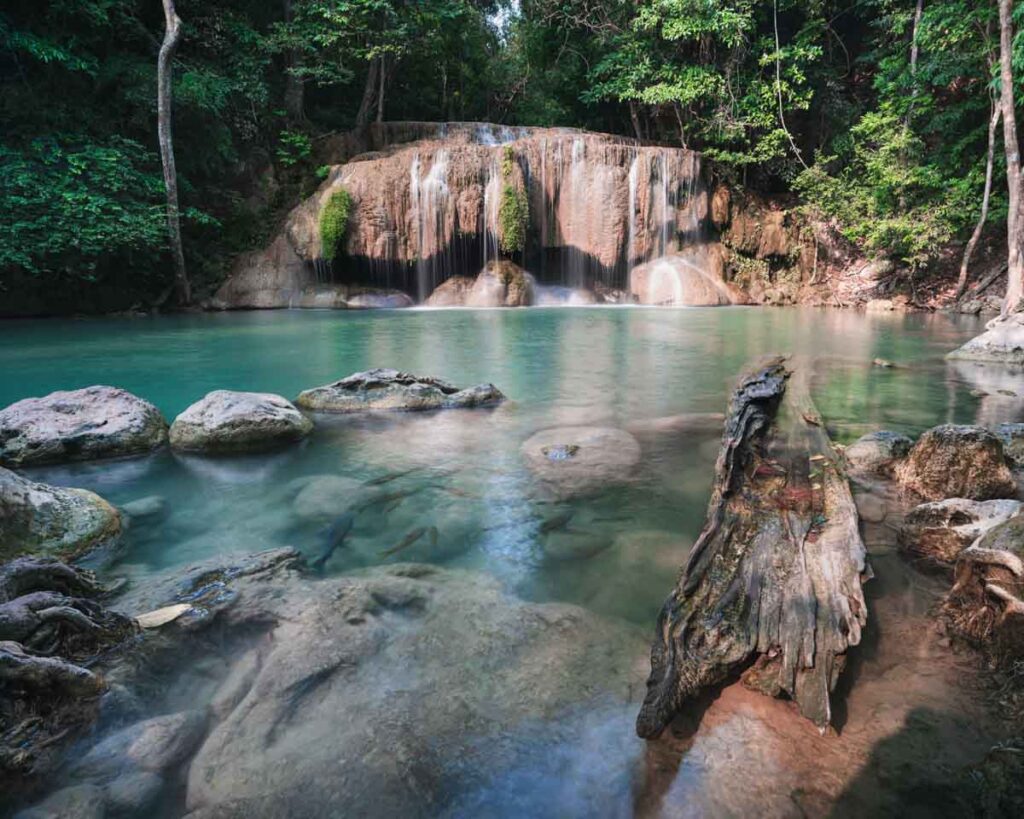
One of the most iconic photography spots in Kanchanaburi and an absolute must if you love waterfall photography. Erawan waterfalls with its seven tiers, turquoise pools, and jungle backdrops are every bit as magical as the photos suggest, just be sure to arrive early to avoid the crowds and catch the best light. It’s one of the top things to do in Kanchanaburi, for good reason.
Somboon Legacy Foundation – Ethical Elephant Sanctuary in Thailand
This is a rare find: a hands-off ethical elephant sanctuary in Kanchanaburi that genuinely puts the well-being of the elephants first. There’s no riding, no bathing, and no forced interaction, just a quiet space where rescued elephants can live with dignity. An excellent stop if you’re passionate about ethical travel in Thailand.

Kanchanaburi Night Market
For food, people-watching and relaxed street photography, the night market is a brilliant local experience. It’s one of the more authentic places to visit in Kanchanaburi, especially if you’re looking to wind down after a day of sightseeing with some great Thai food.

The Death Railway & Bridge Over the River Kwai
A powerful reminder of the area’s WWII history and one of the most visited historical sites in Thailand. It’s a must on any Kanchanaburi itinerary, and best seen early in the morning or at golden hour for atmosphere. If you’re into storytelling through photography, this is a meaningful subject to capture.

FAQs about Visiting Wat Tham Sua (Tiger Cave Temple)
Is there a dress code at Wat Tham Sua?
Yes, there is a sign at the entrance stating that visitors must cover their shoulders and knees. You can rent sarongs at the entrance for around 20 THB if needed, although this wasn’t open when we were there, so it’s best to just arrive appropriately dressed.
Can you fly a drone at Wat Tham Sua?
We didn’t see any signage forbidding it, but always fly respectfully and check for updated rules. Avoid flying over crowds or during religious activities.
How many steps are there at the Tiger Cave Temple Kanchanaburi?
Despite varying reports online, there are fewer than 100 steps to the top of the temple.
Is there a cable car at Wat Tham Sua?
Most guides online advise that there’s a small cable car that operates for around 10 THB, but we saw no sign of it. We recommend checking recent reviews on platforms like TripAdvisor or even Google to see if it’s running or not, if it’s important to you.
Are there toilets at Wat Tham Sua in Kanchanaburi?
Yes – there are basic toilet facilities available at the base of the temple complex.

Is there parking at Wat Tham Sua?
Yes – there is free parking available near the entrance and it was very easy to find a spot.
Are there shops or food stalls at the temple?
There are a few small shops and stalls near the entrance where you can buy drinks or snacks but they were all packed away by the time we arrived at 4pm.
final thoughts on wat tham sua
Wat Tham Sua is a real hidden gem in a lesser-known area of Thailand that not only has some of the most unique architecture we’ve seen but also had literally no crowds at all later in the afternoon.
Both of which are a dream for travel photography.
If you can fit it into your Kanchanaburi itinerary, it is absolutely worthy of a spot!
👉 Planning to explore more of Thailand?
Check out the best places for photography in Northern Thailand!
If you’re heading back to Bangkok then don’t miss this unique Dragon temple!
✨ Share your photos in my Travel Photography Facebook group! ✨
More Thailand Inspiration!
- Visiting Phu Chi Fa Mountains in Thailand – A Photographers Guide
- 2-Week Northern Thailand Itinerary for Photographers
- How to get from Chiang Mai to Doi Inthanon National Park
- Guide to Ang Ka Nature Trail in Doi Inthanon National Park
- Pha Dok Siew Nature Trail – Doi Inthanon National Park
- How to choose an ethical elephant sanctuary in Thailand
- Kew Mae Pan Nature Trail in Doi Inthanon National Park
- Mae Ya Waterfall in Doi Inthanon National Park – A Photographers Guide
- Mae Klang Waterfall in Doi Inthanon National Park – A Complete Guide
- Mae Salong in North Thailand – A 2-Day Itinerary
- Things to do in Doi Inthanon – A Day trip from Chiang Mai
- The Overnight Sleeper Train from Bangkok to Chiang Mai
- How to Visit Thailand’s Sky Temple in Lampang
- How to Travel from Chiang Mai to Bangkok by Day Train
- Ultimate Guide to Wat Sam Phran Dragon Temple in Bangkok
- Visitors Guide To Sirithan Waterfall in Doi Inthanon
- Wachirathan Waterfall in Doi Inthanon – A Complete Guide
- 4 Beautiful Doi Inthanon waterfalls You Shouldn’t Miss
- A Complete Guide to 3 Beautiful Doi Inthanon Hikes
- A Complete Guide to Twin Royal Pagodas at Doi Inthanon
- Chang Chill – An Ethical Elephant Sanctuary in Chiang Mai
- Is It Safe to Drive in Thailand? Everything You Need to Know
- Chiang Mai Lantern Festival: Is it Worth it? An Honest Guide
- 11 Best Places to Visit in Northern Thailand for Photography
- 4 Day Chiang Mai Itinerary for Photographers
- Guide to The Tiger Cave Temple in Kanchanaburi – Wat Tham Sua
- The Photographer’s Guide to Erawan Waterfalls, Kanchanaburi
