
Somboon Legacy – An Ethical Elephant Sanctuary near Bangkok
InWanderment contains affiliate links. If you make a purchase or a booking using these links, we may receive a commission at no extra cost to you. This helps with the cost of running InWanderment. See our Privacy Policy page for more information. We appreciate your support!
Are you planning a trip to Thailand and hoping to visit an ethical elephant sanctuary near Bangkok?
Seeing elephants is one of the top things on every traveller’s Thailand bucket list.
But knowing where to go and what’s actually ethical can feel like navigating a maze.
The truth is, it’s not easy to find ethical elephant sanctuaries in Thailand.
Every place seems to label itself a “sanctuary” and phrases like “no riding” or “rescue centre” get thrown around so casually that it’s hard to know what to trust.
We get it. We’ve been there too.
When I first visited Thailand over a decade ago, I went to a “sanctuary” in Kanchanaburi that didn’t offer riding, which at the time felt like the ethical choice.
But we were still encouraged to feed the elephants, bathe them and even get on their backs in the water. I thought I was doing the right thing. And honestly, the industry just wasn’t where it is now.
Since then, we’ve learned a lot. And here’s what it comes down to:
Truly ethical elephant sanctuaries in Thailand are hands-off.
No feeding. No bathing. No touching. Just respectful observation from a distance that puts the elephants’ needs first.
That’s why, after careful research and years of learning, we chose to spend a month volunteering at Somboon Legacy Foundation, a non-profit, forward-thinking organisation and a genuine ethical elephant sanctuary in Kanchanaburi. Just a few hours from bustling Bangkok.
This post isn’t here to judge. It’s here to help.
After extensive research into elephant tourism and months spent travelling in Thailand, we now have so much more knowledge than we did ten years ago.
By the end of this post, you’ll feel confident choosing an ethical elephant sanctuary and know exactly what to expect when you visit Somboon.

What Makes an Elephant Sanctuary Ethical?
Not all sanctuaries are what they claim to be, even if the word “ethical” is right there in the name.
So, what actually makes an elephant sanctuary in Thailand genuinely ethical?
The short version: it puts the elephants first. Always.
Finding a truly ethical elephant sanctuary near Bangkok or elsewhere in Thailand takes a little digging, but it’s absolutely possible and well worth the effort.
At its core, ethical elephant tourism means no riding, no bathing and no direct interaction.
Elephants are free to roam, forage, form bonds and behave in ways that are natural to them, not perform for people.
Here are a few things to look out for when choosing an ethical sanctuary: 👇
✅ Elephants can move freely and forage throughout the day
✅ There are no tricks, shows, riding, bathing or hands-on contact with visitors
✅ Mahouts use positive reinforcement rather than punishment or control
✅ Elephants live in social groups, not in isolation
✅ There’s no breeding unless it supports genuine conservation or rewilding efforts
Sadly, many places still market close encounters as “ethical,” even though they often involve unnatural behaviour, stress, or subtle forms of control.
Regardless of whether they’re taken from the wild or born in captivity, elephants used for close tourist interactions like bathing have typically been subjected to a deeply distressing training process known as the ‘crush’.
This brutal method involves tearing young calves away from their mothers, isolating them, withholding food and water and often subjecting them to repeated beatings until their spirit is broken and they respond out of fear.
In a truly ethical elephant sanctuary in Thailand, bathing won’t be offered at all.
We found trusted resources like Call to Conserve, Animals Asia, World Animal Protection and Connie Needham really helpful in understanding what ethical elephant care actually looks like and what to steer clear of.
If you’d like to learn more, we’ve also broken it down step-by-step in our full guide to choosing an ethical elephant sanctuary in Thailand.

💡 Planning a trip but not sure where to start? 🤔
👉 Grab your FREE Guide to 50+ of the BEST travel apps – Apps to help you navigate, find volunteer roles, house swapping, transport, planning, and more!
✈️ As full-time travel photographers, we’ve personally tested and used every app in this guide during our 18 months on the road, and they honestly made travel smoother, smarter, and way more fun.
📩Pop in your email and we’ll send it straight over – hope it helps make your next adventure a little easier!
Why We Chose Somboon Legacy Foundation – an ethical elephant sanctuary in Kanchanaburi
With so many places advertising “ethical” elephant experiences, it can be hard to separate genuine sanctuaries from those simply using the right language.
One of the most well-known names in Kanchanaburi is Elephant’s World.
It’s often the first place that comes up when people search for an elephant sanctuary near Bangkok and it markets itself as a rescue centre.
Like many travellers, I visited Elephant’s World over ten years ago and back then it was one of the few places that didn’t offer riding and I genuinely thought I was doing the right thing.
But sadly, not much has changed since then.
Despite its popularity, Elephant’s World still offers activities like elephant bathing, mud baths, feeding and close contact with visitors.
These experiences are often marketed as ethical alternatives, but they still revolve around tourist entertainment, not what’s best for the elephants.
The thing is, elephants are wild animals, not pets.
Being handled by dozens of strangers, bathed and smeared with mud every single day, is not normal behaviour for them and in fact, it’s incredibly stressful.
It’s not something they choose.
They’re kept on a strict daily schedule designed to give visitors a feel-good experience, even though it often causes stress and disrupts their natural behaviours and takes away their free will.
In fact, the only reason they tolerate this type of contact with humans is because they are trained in a brutal way from a young age in a process known as “the crush”.
And once you see it that way and learn the truth, it becomes hard to justify and impossible to ignore.
It might be your once-in-a-lifetime moment but for the elephants, it’s their everyday.
We came to understand all of this more clearly after spending time on the Call to Conserve website, a brilliant, independent resource that breaks down what ethical elephant care really looks like.
Elephant World is absent from their list of ethical elephant sanctuaries in Thailand due to the close contact and activities it offers.
But Somboon Legacy Foundation in Kanchanaburi is listed as one of the few truly ethical sanctuaries in Thailand.

That’s why we chose to visit Somboon.
Somboon takes a fully hands-off approach. There’s no bathing, no feeding and no touching, just quiet, respectful observation.
Elephants are free to roam the forest, forage, rest and interact on their own terms. It’s a space that prioritises their needs, not our photo opportunities and selfies. (although we still got amazing photographs!)
It also happens to be accessible from both Bangkok and central Kanchanaburi.
After reading guidance from groups like Call to Conserve and Animals Asia and spending a full month volunteering on-site, we’re confident in saying that Somboon Legacy Foundation is the most ethical elephant sanctuary in Kanchanaburi and the most ethical elephant sanctuary near to Bangkok.
It’s a true example of what responsible elephant tourism in Thailand can and should look like.

What It’s Really Like to Spend a Day at This Hands-Off Elephant Sanctuary
What Ethical Elephant Tourism Really Looks Like
Before we dive in, it’s worth saying we’re not just sharing this from the perspective of a one-off visit. We actually volunteered at Somboon Legacy Foundation for a whole month, so we got to know the place properly.
We helped run tours, worked alongside the mahouts and spent time around the elephants every day.
So what you’ll find here isn’t just a highlight reel, it’s an honest look at what the experience is really like, over and over again.
Here’s what you can expect from a visit.👇
🕘 Tour Options at Somboon
There are a few different ways to visit Somboon:
- Half-day tours (either morning or afternoon)
- A full-day visit
- Or an overnight stay in one of their lovely cabins
If you’ve got time, we really recommend going for the full day.
Seeing elephants this way, no pressure, no touching, no touristy performances, is honestly something quite rare and you won’t want to rush it.
Plus, the day goes so quickly and you’ll get to see the elephants more than once, often in totally different moods or settings.
And if you fancy staying overnight?
The cabins at Legacy River Kwai Resort are beautiful. You’re surrounded by nature, there’s a pool, a great little restaurant and the vibe is so peaceful. We stayed in them ourselves and it’s such a good way to properly soak it all in.

🐘 Observing the elephants
I still remember the first time we saw the elephants, I was genuinely close to tears.
You head out on a walk through the grounds, tracking where they are that day. Once you find them, you keep a respectful distance, 20 metres away at all times and just quietly watch.
One of the guides (it might be one of the owners, or a volunteer like we were) shares a bit about each elephant, their past, their quirks, the way they interact with each other.
You’ll learn to recognise little behaviours too like when they’re foraging for bamboo, having a nap, or even giving themselves a mud bath.
It’s completely natural. Nothing’s staged and the elephants decide what they want to do and how they want to behave. You can ask loads of questions, take plenty of photos (from a distance) and just get to see elephants being elephants.


🌿 Cutting Banana trees and Prepping Food
This part is actually really fun and surprisingly satisfying.
Depending on the season, you’ll help cut banana trees, which are used to supplement the elephants’ diet. It’s a job the mahouts do every single day, whether there are guests there or not, so it gives you a bit of a window into the daily care routine.
Later, you’ll get to watch the elephants enjoying the food you helped gather, which is a pretty amazing feeling and yet another chance to fill up your camera reel.


🍚 Cooking Sticky Rice & Preparing Fruit Salad
Elephants eat a lot and for older or rescued elephants, they need a bit of extra support too.
At Somboon, you’ll help prepare a sticky rice mix with added vitamins, plus chop up fresh fruit into a big, colourful elephant-style fruit salad.
It’s another chance to chat with the mahouts and volunteers and learn more about each elephant’s diet and health. Then, you head over to the viewing platform to watch them enjoy it all, without any hand-feeding. Only the mahouts do that here, to help the elephants stay as independent and natural as possible.
It’s another peaceful moment that’s perfect for observing and photographing.


🧑🌾 Meeting the Mahouts
One thing that really stood out to us was just how important the mahouts are and how misunderstood their role can be.
It’s easy to assume that in a sanctuary, elephants should be completely free.
But the truth is, most rescued elephants can’t survive on their own. Many have spent years in the logging or tourism industries and wouldn’t know how to forage properly or avoid danger in the wild.
The mahouts are there to:👇
💓 Keep them safe within the sanctuary
💓Monitor their health and check for injuries
💓Give them medication and supplements each day
At Somboon Legacy Foundation, the relationship is built on trust and care, not control.
You’ll get to meet the mahouts, see how they work and understand just how vital their role is. It’s a side of elephant care that’s often left out of the conversation, but it’s so important.

🧠 The Interactive Elephant Museum
This is one of the most unique things about Somboon and honestly, a big reason we believe it’s the best elephant sanctuary in Kanchanaburi.
They don’t just care for elephants, they educate people, too.
The on-site elephant educational museum is interactive and really thoughtfully done.
There are facts, models, photos, even a life-size mammoth skeleton. It’s brilliant for kids, but we learnt loads too. They’re passionate about inspiring the next generation to treat elephants better and it really shows.

📜 Poo Paper Factory (Yes, Really)
Now for something a bit different: poo paper!
It sounds odd, but it’s actually pretty cool.
The sanctuary makes eco-friendly paper products from cleaned, processed elephant dung and you can have a go at making your own. No, it doesn’t smell and yes, it’s surprisingly fun.
You’ll find beautiful poo paper posters in the shop that you can purchase and it’s all supporting the sanctuary’s green goals.

🛍 Shopping That Feels Good
The gift shop at Somboon is full of genuinely lovely, meaningful souvenirs, everything from hand-drawn elephant sketches to bracelets and cuddly toys.
And since all the money goes straight back into caring for the elephants, it’s guilt-free shopping. (Full disclosure – I may have spent a little too much here on my first shift…)
🌊 Watching Elephants Bathe – No Crowds, No Chaos
Towards the end of the day, the elephants are guided to the River Kwai Noi for a swim.
They don’t have 24/7 river access due to the land layout, so this is a daily highlight but unlike other places, you’re not in the water with them.
You’re up on a wooden platform, watching from a distance as they splash, spray, sometimes trumpet with joy, or just wade quietly.
Sometimes the mahouts help out, especially if an elephant has a cut that needs cleaning but otherwise, it’s completely up to the elephants. It’s calm, unforced and honestly one of the most memorable parts of the whole experience.
The next best thing you get to watch is them getting out of the river.
Every single time, without fail they head to the trees and start covering themselves in dirt and dust. Its a natural behaviour that elephants do in the wild after bathing and so it makes it even more lovely to watch.
This isn’t your average tourist elephant experience, it’s an honest, hands-off day that lets elephants lead the way while you quietly observe.
Just a quick note: these are the different elements that may be included across the various tours, but not everything happens on every visit, especially if you choose the half-day option.
For the full breakdown of what’s included, it’s best to check the latest details on the Somboon Legacy Foundation website here.

🎥 Video of Somboon Legacy Foundation Tour
We actually created a short video for Somboon as part of our volunteer projectand it gives a real sense of what a full day at the foundation looks like – from forest walks to river baths and everything in between.
If you’re curious to see what it’s like before you go, it’s well worth a watch. Enjoy!

How to Visit Somboon Legacy Foundation (And a Few Tips to Help)
Booking a visit to Somboon Legacy Foundation is really simple and best of all, you’re booking directly with the team, so your money goes exactly where it should: towards the ongoing care of the elephants and support for the people protecting them.
Here’s exactly how to book: 👇
How to book Somboon Legacy Foundation
Step 1: Visit the Somboon Legacy Foundation Website
Head to their official site where you’ll find details about the different experiences on offer, including half-day, full-day and overnight stays as well as what’s included in each one.
Step 2: Choose Your Experience
Decide whether you want a half-day or full-day visit. Both include transport from Kanchanaburi town, but the full-day experience includes additional learning activities like cooking sticky rice and the elephant museum. Trust us, it’s worth the extra time.
Step 3: Fill in the Booking Form
You’ll be asked for your name, travel dates, contact details, preferred languageand any dietary requirements. The tours can be done in several languages, which makes them really accessible.
Step 4: Wait for Confirmation
You’ll usually get a reply from the Somboon team very quickly, often the same day. If you have any questions, they’re brilliant at responding via email or WhatsApp.
Step 5: Pay on the Day
There’s no need to pay a deposit or book through a third-party platform. Just bring the correct amount in cash and pay when you arrive. It keeps things simple and makes sure 100% of your money supports the foundation directly.

A Quick Note on Tour Platforms
💡 While we sometimes recommend platforms like Get Your Guide or Viator for city tours or boat trips, we don’t recommend using them for animal experiences, especially when it comes to elephants.
We searched high and low and couldn’t find a single hands-off, ethical elephant sanctuary near Bangkok listed on those platforms. Every option we found still included bathing, feeding, or close contact, which goes against the core of ethical elephant tourism.
There is one exception, though:👇
👉 Seek Sophie – a responsible travel platform that only lists thoroughly vetted ethical experiences. You’ll find genuinely hands-off elephant sanctuaries on there, so it’s a great option if you’re booking multiple ethical activities in Thailand. For Somboon, however, you’ll need to book directly as Seek Sophie is yet to expand into attractions in Kanchanaburi but we highly recommend them for other animal experiences!

What’s Included on Your Visit to Somboon Legacy Foundation
What’s included in your visit depends slightly on which tour you book, but here’s a general idea of what you can expect. Just be sure to check the Somboon Legacy Foundation website for the most up-to-date info when you book.
Full-Day Tour Includes:
✅ Return transport from Kanchanaburi town to Somboon Legacy Foundation
✅ An English-speaking guide (also available in other languages)
✅ Lunch at the riverfront restaurant
✅ Drinking water is available throughout the day
✅ An Elephant Booklet for children up to 13 – a lovely, educational touch if you’re travelling as a family
✅ Transport between on-site activities – so you don’t need to do loads of walking between locations
✅ Wi-Fi at the restaurant and museum (ideal if you want to share a few snaps or stories on the go)
✅ Free parking if you’re arriving by car or scooter
Half-day visits include many of the same elements, including lunch and some of the enrichment activities but you will miss on a few key things depending on when you visit which is why we think the full-day experience is the best way to go if you can.

What to Bring With You
A visit to Somboon Legacy Foundation isn’t a polished tourist attraction. It’s a real walk through the trees, sometimes over uneven ground and you’re outdoors most of the day. Expect mud, bugs, sun and the occasional sweaty moment but that’s part of what makes it feel so real.
Here’s what we recommend wearing and bringing to make your visit more comfortable.👇
What to Wear
✅ Lightweight, breathable clothing – it gets hot in the forest, especially in the dry season
✅ Long sleeves and trousers – not essential, but useful for sun and bug protection
✅ A hat or cap – especially helpful during the midday heat
✅ Comfortable walking shoes or trail trainers – nothing fancy, but something with grip. Some paths are uneven or a bit slippery in places
What to Take With You
✅ A refillable water bottle – we recommend Water-to-Go filter bottles, as they can be used almost anywhere and filter out viruses and bacteria. Keeping you hydrated and safe and reducing single-use plastics!
✅ Sunscreen and insect repellent – both are essential
✅ Camera or phone – both are absolutely fine
✅ Spare battery or power bank – it’s a full day and trust us, you’ll take more photos than you expect

Photography Tips for Visiting Somboon Legacy Foundation
If you’re visiting Somboon Legacy Foundation with photography in mind (like we were), it’s worth being prepared, but not overloaded.
The setting is natural, the pace is relaxed and the best images come from just quietly observing.
Here are a few simple tips to help you get the most out of the experience:👇
- You don’t need a massive zoom – most of the time, the elephants are close enough for a standard or mid-range lens. A zoom can be helpful for picking up detail, but it’s not essential.
- Skip the tripod – the trails are forested and uneven and you’ll be on the move a lot. A tripod will just weigh you down. Keep your kit light and portable.
- Be mindful of others in your group – everyone wants their moment. Once you’ve got your shot, take a step back and give others the space to enjoy it too.
- Always respect the 20-metre distance – this isn’t just a rule, it’s part of what makes Somboon ethical. The elephants’ space comes first and sticking to that respectful distance often results in more natural, storytelling images anyway.
- Use silent shutter mode if you can – it’s a small thing, but switching to a quiet or silent mode helps keep the experience peaceful, for the elephants and the people.
You don’t need anything too technical or high-end to photograph here.
Some of our favourite images were the spontaneous, unposed ones. Elephants wandering through the trees, shaking dust over themselves, or reaching for bamboo.

📸 FREE Guide – 11 Simple Tips To Elevate Your Travel Photos
✅ Designed to help anyone take better travel photos, with no technical jargon, no confusing settings, and no need for fancy gear.
🎉 Simple, practical tips to take better photos – whether you’re using a camera or your phone!
Best Time to Visit Somboon Legacy Foundation
Thailand’s seasons can make a big difference to your experience, especially at a place like Somboon Legacy Foundation, where most of your time is spent outdoors and walking through the forest.
Here’s a breakdown of what to expect throughout the year, including the one month we’d definitely not recommend (and we’re speaking from sweaty, sun-scorched experience!).
☀️ Cool & Dry Season (November to February)
- Generally, the best time to visit – clear skies, lower humidity and much more manageable temperatures
- Ideal for walking – the forest trails are drier and more comfortable underfoot
- Photographers: expect soft golden light in the mornings and evenings, plus clearer skies for those long-lens shots
- This is also the busiest time of year, so it’s worth booking ahead if you’re planning a trip in peak season
🔥 Hot Season (March to May)
Let’s talk about April. We volunteered throughout the month and it’s not just the hottest time of year in Thailand, it’s one of the hottest places in Thailand too. Temperatures were between 40–45°C every single day.
We’re not exaggerating when we say people were fainting. It was that hot.
If you’re someone who struggles with heat or prefers a more active experience, it might not be the most comfortable time to visit. That said, it’s still totally doable with preparation – just bring plenty of water, wear breathable clothesand take regular breaks in the shade.
The upside? Fewer visitors and beautiful early morning light.
🌧️ Rainy Season (June to October)
- The forest is at its greenest and most lush, which makes everything look even more magical
- Expect daily showers, usually short, heavy bursts in the afternoon
- Trails can get slippery and a bit muddy, so good footwear is a must
- Fewer tourists around, which means a quieter, more peaceful experience
- Photographers: lots of moody, atmospheric light – just bring a lens cloth and be ready for a bit of mist

Our recommendation? Aim for November to February for the most comfortable visit, or head towards the later part of the rainy season (September–October) if you want greenery and fewer crowds.
April? Only if you’re heat-proof, sun-hardened, or just really committed, we survived it, but just about.
Other Ethical Elephant Sanctuaries in Thailand
(And Why We Always Use Call to Conserve)
While we believe Somboon Legacy Foundation is the best and most ethical elephant sanctuary near Bangkok, there are some fantastic places in other parts of Thailand that also follow truly ethical, hands-off models.
When we’re researching elephant experiences, we always turn to the Call to Conserve website. It’s independent, regularly updated and most importantly, it’s not sponsored or swayed by tourism partnerships.
It’s one of the few places we trust for unbiased advice on which sanctuaries genuinely put the elephants first.
If you’re heading further north or south in Thailand and want to extend your elephant experiences, here are a few other places that come highly recommended by Call to Conserve:
Northern Thailand
- Chang Chill – Mae Wang District, Chiang Mai
Fully hands-off, educational and supported by World Animal Protection. We’ve visited and loved it. You can read our full review here .
- Kindred Spirit Elephant Sanctuary – Mae Chaem District, Chiang Mai
Community-led and focused on rewilding. Visitors hike into the forest to observe elephants living naturally.
- Mahouts Elephant Foundation – Karen Hill Tribe, Chiang Mai
A non-profit focused on low-impact, ethical tourism and deep community involvement.
- Isara Elephant Foundation – Karen Hill Tribe, Chiang Mai
Observation-only and values-led, with strong attention to welfare.
- Burm and Emily’s Elephant Sanctuary (BEES) – Mae Chaem District, Chiang Mai
A retirement sanctuary giving elephants space, freedom and dignity
- Boon Lott’s Elephant Sanctuary (BLES) – Sukhothai
Dedicated to ethical rescue, rehabilitation and long-term care in a natural setting.
- Elephant Nature Park – Mae Taeng District, Chiang Mai
Mentioned as it is one of the most famous in the North of Thailand, but it is not endorsed or recommended by the World Animal Protection due its close contact with elephants. Choose Chang Chill instead.
Southern Thailand
- Following Giants – Ko Lanta, Krabi
A rewilding sanctuary where elephants roam the forest freely, with minimal human interference.
- Phuket Elephant Sanctuary – Phuket
One of the better-known sanctuaries in the south. Some close-contact activities still take place, but the observation-only tours are a good choice. (They’ve also announced that from April 2026, feeding interactions will be phased out – a brilliant step forward.)

Seeing Elephants in the Wild in Thailand
We haven’t done this ourselves yet, but seeing elephants in the wild is very much on our bucket list. It’s one of the most respectful and non-intrusive ways to experience these incredible animals, if it’s done ethically.
There are a few places in Thailand where wild elephants still roamand guided tours can offer a chance to spot them (from a distance) in their natural environment.
Here are the main options:👇
- Kui Buri National Park – Prachuap Khiri Khan Province
Often considered one of the best places to see wild elephants in Thailand. The park is known for its responsible approach and relatively high chance of sightings.
- Khao Yai National Park – Around three hours from Bangkok
Thailand’s oldest national park, with a wide range of wildlife. Elephant sightings are less predictable but still possible, especially early in the morning or late in the day.
- Kaeng Krachan National Park – Western Thailand
A huge, remote park with a healthy elephant population, but it’s harder to access and less developed for visitors. Best for experienced wildlife travellers or those with a guide.
Even if you’re planning to see elephants in the wild, it’s still important to do your research. Not every wildlife tour is ethical and if a company guarantees sightings, that’s usually a red flag.
The most responsible experiences don’t promise anything. They rely on patience, timing and a bit of luck, which is exactly how it should be.
Before booking, take time to:👇
✅Read recent reviews
✅Check whether the park or operator has a conservation focus
✅Ask questions ahead of time if anything feels unclear
If it feels too easy or too perfect, it might not be what it claims to be.

Volunteering with Elephants in Thailand: What It’s Like at Somboon
If you’re looking for a meaningful way to spend time in Thailand and truly make a difference, volunteering with elephants in Thailand at a hands-off elephant sanctuary like Somboon Legacy Foundation might just be it
We volunteered here through Workaway and can honestly say it was one of the most rewarding things we did during 18 months of travel.
It’s not a tourist experience. It’s not a photo-op. It’s hard work, eye-opening and something we’ll remember for life.
Here’s what you need to know:
✅It’s a minimum commitment of one month. You become part of the team and take on real responsibilities.
✅You pay a small fee, which covers your food and accommodation. The fee helps support the foundation and also makes sure you’re well-fed, rested and looked after.
✅You’ll be on a rota and the work is real. Tasks can include anything from helping prep meals for the elephants, chopping grass, cleaning areas after tours, supporting guests, or helping with education materials. No two days are quite the same. If you have a specific skill or interest, then Somboon will be happy to assign you a project focused on this, like we did with our photography and video. We saw volunteers building things, painting murals, designing art books and there are so many options to support the foundation.
✅You will not touch or interact directly with the elephants. The 20-metre distance rule applies to everyone, even the owners and volunteers. Only the mahouts have close contact. And honestly, that’s one of the reasons we loved it. Respect is built into every part of the experience.

What’s life like on-site?
🏡 You’ll stay in simple but lovely wooden cabins – no air con, but there are fans, proper showers and comfy beds. If we managed in 45°C heat in April, you’ll be fine too!
💦 There’s a swimming pool you can use in your downtime (and believe us, you’ll appreciate it after chopping banana trunks in the midday heat).
🍜 Meals are served at the on-site restaurant run by Pato – an absolute gem of a human who serves up tasty, filling food every day with lots of veggie options! Unlimited drinking water is included too.
A few Honest Thoughts
Only apply if you’re ready to work hard and truly show up.
This is a place that runs on passion and teamwork and while there’s time to relax, it’s very much a working environment. If you throw yourself in, you’ll be welcomed with open arms and come away with new skills, new friends and a connection to something bigger than yourself.
Volunteering here means real work, real impact and a rare look at ethical elephant care in practice.
We made lifelong friends here, people we’re still in touch with, even months later.
There’s something about living and working side by side in a place like this that really bonds you.
And the memories? Honestly, some of our best from Thailand.

How You Can Help Change the Elephant Tourism Industry
We know it can feel completely overwhelming.
When we travelled through Thailand for four months, we saw it all.
Elephants chained beside the road. Camps still offering rides. Experiences dressed up as “eco-tourism” that were anything but.
And maybe the hardest part?
Watching people we care about, friends, even family, posting about elephant bathing and calling us “over the top” for speaking out.
Honestly, it’s disheartening.
But here’s the thing: we can be the change. In fact, we have to be.
If you’ve made it this far, you probably care as much as we do. So here are four ways you can help move the elephant tourism industry in a better direction:👇
1. Book Ethical, Hands-Off Sanctuaries – and Shout About Them
Support the places that are actually doing things right, where there’s no touching, no bathing, no riding. These kinds of sanctuaries don’t usually have big marketing budgets. They rely on word of mouth, honest reviews and travellers who care enough to spread the word.
✅Share your experience on social media
✅Tag the sanctuary in your posts
✅Leave a thoughtful review
✅Talk to your friends and family about it
✨Your voice has more power than you think.✨

2. Support the Voices Making a Difference
We’ve learned so much from conservationists, advocates and educators who use their platforms to spread awareness about elephant welfare. Even a simple like, comment or share helps boost their content and reach more people.
And that ripple effect really matters.
Here are a few accounts we recommend following:👇
👉 @danielle4wildlife
👉 @connie.needham
👉 @planeta_praneetha
👉 @wildtesa
👉 @wildlifewithmia

3. Don’t Engage With the Bad Stuff
It’s tempting to comment when you see someone bathing or hugging an elephant in a viral video especially when you know it’s not okay.
But the hard truth? Engagement boosts visibility.
Instead:
✅Report it (especially on Instagram – it makes a difference)
❌Don’t comment
✅Focus your energy on sharing ethical content that educates and inspires
Be part of shifting the algorithm in the right direction.

4. Speak Out – Even When It’s Uncomfortable
It’s not always easy to challenge the norm. But saying something, even gently, can open the door for others to learn.
Most people simply don’t know. I didn’t, 11 years ago when I bathed an elephant myself. I wish someone had told me.
But once you know better, you can do better. And when you share what you’ve learned, others can too.
Since we started speaking up, we’ve had so many messages from people saying, “Thank you – I honestly had no idea.”
That’s the power of speaking out. You might be the reason someone makes a kinder choice next time.

Resources to Learn More
If you want to dive deeper into the world of ethical elephant tourism, these are some of the voices and platforms we genuinely trust. They offer clear guidance, honest conversations and up-to-date resources that can help you travel more consciously and avoid the marketing traps.
🐘 Call to Conserve / danielle
Founded by Danielle, this site is one of the best independent resources out there. Her Instagram is packed with reels, breakdowns and myth-busting info and her website includes a vetted list of genuinely ethical elephant sanctuaries across Asia, including Thailand. This was our go-to when planning our visit to Somboon.
🐾 Connie Needham / Project Wild
Connie’s content is smart, clear and super accessible. She shares honest insights into the realities of animal tourism, particularly around elephants and monkeys. Her reels are brilliant if you want to learn quickly and understand the big picture.
🧭 Animals Asia
A long-standing voice in animal welfare across Asia. They run awareness campaigns around the treatment of captive animals, including elephants and offer helpful resources on choosing responsible tourism options.
✋ World Animal Protection
A global charity working to end the exploitation of animals in tourism. They actively promote truly ethical sanctuaries, ones that don’t allow riding, feeding, bathing, or other harmful practices.
If you’re ever unsure about a sanctuary or wildlife experience, start with one of these. They’re honest, researched and rooted in animal welfare, not profit.
And if you haven’t already, have a read of our full guide on how to choose an ethical elephant sanctuary in Thailand – it breaks down red flags, green flags and exactly what to look for when booking.

Why We Talk About Ethics in Animal Tourism
You might be wondering why a travel and photography blog like ours is so focused on ethical elephant tourism in Thailand and the short answer is: because it matters
Wildlife is a huge part of travel.
Whether it’s spotting elephants in Thailand, watching monkeys leap through the jungle, or photographing birds in flight, these are often the moments we remember most. But how we experience wildlife makes a world of difference.
We’ve made mistakes ourselves, feeding monkeys before we understood the impact, bathing elephants, thinking it was a kind alternative to riding.
But we’ve learned. And over the years, we’ve become much more aware of how our actions as travellers and photographers affect the very animals and environments we care about.
That’s why we choose to highlight places like Somboon Legacy Foundation, sanctuaries that truly put animal welfare first. We don’t promote just any elephant tour. If something doesn’t align with what we believe is best for the animals, we simply won’t share it.
We also point our readers towards responsible companies like Seek Sophie, who are doing the hard work of vetting experiences so travellers can make better choices.
For us, ethical travel and photography go hand in hand. We want to help protect the planet, not just photograph it. And we know so many of you feel the same.
This is just the beginning. We’ll be sharing more responsible wildlife experiences on the blog, along with the dos and don’ts we’ve picked up along the way.
Our hope is that it helps you travel better, experience more genuine encounters and play a small but meaningful part in creating a more ethical future for animal tourism.

Ethical Elephant Tourism FAQs
What is the most ethical elephant sanctuary in Kanchanaburi?
There’s only one truly ethical elephant sanctuary in Kanchanaburi and near to Bangkok and that’s Somboon Legacy Foundation. It is a completely hands-off elephant sanctuary: no feeding, no bathing and no posing for close-up photos. Just respectful observation from a distance, exactly as it should be.
Is it okay to bathe elephants?
No. Bathing elephants is not ethical. These are still wild animals and repeated close contact, even in water can cause stress and suppress natural behaviours. Just because an elephant allows it doesn’t mean it enjoys it. If bathing is part of the experience, it’s a sign that the sanctuary is prioritising tourism over animal welfare.
Are there ethical elephant sanctuaries in Thailand?
Yes there are a few truly ethical elephant sanctuaries in Thailand that follow hands-off practices, but not as many as the marketing might suggest…
Lots of places call themselves sanctuaries, but still allow touching, feeding, or bathing. That’s not truly ethical. We always recommend checking independent resources like Call to Conserve and reading recent reviews to make sure what’s being promised is actually what’s delivered.
What is the best elephant sanctuary to visit if I want to interact with elephants?
If interaction is what you’re after, it might be time to rethink the goal. Direct contact, including feeding or hugging, is a red flag. Instead, choose places like Somboon Legacy Foundation, where elephants are allowed to just be elephants and visitors are there to observe, not interfere.
Is it okay to feed or touch elephants?
No. Even if it feels harmless, feeding and touching elephants can negatively impact their well-being. It encourages unnatural behaviours, causes stress and can even be dangerous. Ethical sanctuaries avoid these kinds of interactions and that’s a good thing.

Is Somboon Legacy Foundation a no-contact, hands-off sanctuary?
Yes. 100%. There’s no touching, feeding, or bathing. Visitors observe the elephants from a distance as they forage, rest, roam and interact with each other naturally. That respectful space is what makes Somboon truly ethical.
How many elephants live at Somboon Legacy Foundation?
There are currently four elephants living at Somboon. It’s not about numbers here, the sanctuary is open about its size and capacity. Instead, the focus is on education, long-term care and building a better future for elephant tourism.
Can I take photos at Somboon?
Absolutely and we definitely recommend bringing your camera! Just be mindful of the 20-metre distance rule and avoid crowding or blocking others. There are loads of beautiful moments to capture, but none of them are staged or forced.
Is Somboon Legacy Foundation suitable for children or older visitors?
Yes, it’s a great experience for all ages. The walking is light and mostly on flat, even ground. There’s also a buggy available to take guests between areas if needed, so it’s fully accessible and suitable for those with mobility concerns.
Is Elephant World in Kanchanaburi ethical?
According to guidelines on ethical sanctuaries, no Elephants World is not ethical. Elephant World still includes close-contact activities like feeding, mud bathing and washing elephants in the river, all of which put tourism above the animals’ wellbeing. While they’ve removed riding, the remaining practices are still not in the elephants’ best interests.

Improve Your Photos!
✨ FREE 11 Simple Tips To Elevate Your Travel Photos ✨
Simple, practical tips to take better travel photos – whether you’re using a camera or your phone!
👉 No confusing camera speak, no settings to mess around with, just easy tips you can use straight away 👈
What else is there to do in Kanchanaburi?
If you’re building your Kanchanaburi itinerary, there’s no shortage of beautiful, cultural and historic spots to explore.
From jungle waterfalls to scenic temples and bustling local markets, here are some of the top places to visit in Kanchanaburi.
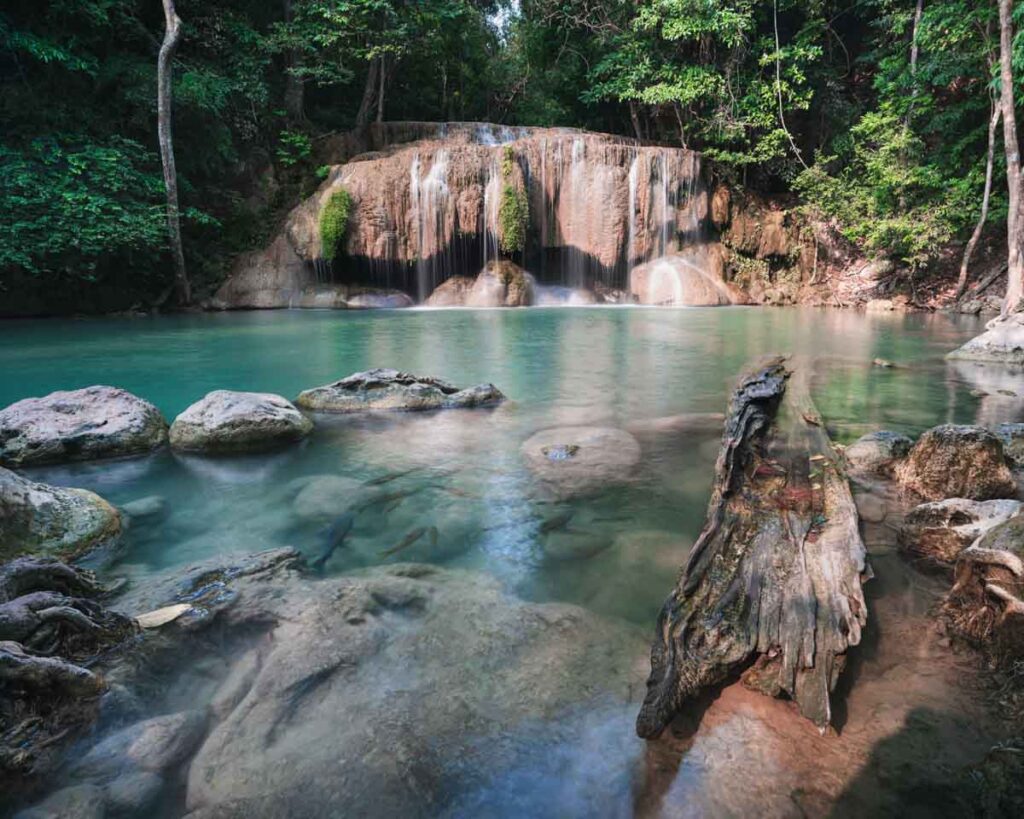
Erawan Falls
A must if you haven’t already been. These seven-tiered waterfalls are one of the most iconic things to do in Kanchanaburi and hands down one of the best photography spots in Thailand for waterfall photography. Go early to catch the soft light and beat the life-jacket crowds.
Wat Tham Sua – The Tiger Cave Temple
Perched on a hill with sweeping rice field views, this dramatic temple is easily one of the best photography spots in Kanchanaburi. With golden chedis, peaceful vibes and far fewer tourists than temples in Bangkok, it’s a real hidden gem.

Kanchanaburi Night Market
A great way to spend your evening. It’s laid-back, local and full of amazing food and it’s one of the more authentic places to visit in Kanchanaburi if you’re after good eats and casual street photography.

The Death Railway & Bridge Over the River Kwai
Steeped in history, this is one of the most famous things to do in Kanchanaburi. It’s a sobering yet important site to visit, especially if you’re interested in WWII history. We recommend visiting early morning or golden hour for the most atmospheric shots.

Where to Go After Kanchanaburi?
So, you’ve wandered through waterfalls, explored jungle trails and temples, and soaked up all the vibes in Kanchanaburi and now you’re thinking… where to next?
The good news? You’ve got loads of fab options, depending on what kind of trip you’re after.
Fancy Heading Back to Bangkok?
You could totally swing back to Bangkok for a bit.
If you didn’t get chance to see much the first time around, this is a great excuse to explore a bit deeper. There are loads of hidden temples, little local markets, and river spots that most people miss.
Plus, it’s a good way to break up the journey and grab a few more golden hour city shots while you’re at it!

Or How About Heading North?
This is what we did, and honestly, it was such a highlight of our trip.
We hopped on the sleeper train up to Chiang Mai and absolutely loved it. It’s such a fun experience, you fall asleep in one part of Thailand and wake up in a totally different landscape.
And let’s be honest, it’s always a win when your transport doubles as your accommodation!
Northern Thailand is just dreamy, think misty mountains, peaceful temples, and so many gorgeous photo spots that we completely fell in love with. Just rent a car and start exploring!
Wherever you decide to go next, Kanchanaburi sets the bar pretty high… but trust us, Thailand’s got plenty more magic in store.

Mavic 3 Camera Settings – ISO-100, f/5.6, 1/800 sec, 12mm
✨ Share your photos in my Travel Photography Facebook group! ✨
More Thailand Inspiration!
- Visiting Phu Chi Fa Mountains in Thailand – A Photographers Guide
- 2-Week Northern Thailand Itinerary for Photographers
- How to get from Chiang Mai to Doi Inthanon National Park
- Guide to Ang Ka Nature Trail in Doi Inthanon National Park
- Pha Dok Siew Nature Trail – Doi Inthanon National Park
- How to choose an ethical elephant sanctuary in Thailand
- Kew Mae Pan Nature Trail in Doi Inthanon National Park
- Mae Ya Waterfall in Doi Inthanon National Park – A Photographers Guide
- Mae Klang Waterfall in Doi Inthanon National Park – A Complete Guide
- Mae Salong in North Thailand – A 2-Day Itinerary
- Things to do in Doi Inthanon – A Day trip from Chiang Mai
- The Overnight Sleeper Train from Bangkok to Chiang Mai
- How to Visit Thailand’s Sky Temple in Lampang
- How to Travel from Chiang Mai to Bangkok by Day Train
- Ultimate Guide to Wat Sam Phran Dragon Temple in Bangkok
- Visitors Guide To Sirithan Waterfall in Doi Inthanon
- Wachirathan Waterfall in Doi Inthanon – A Complete Guide
- 4 Beautiful Doi Inthanon waterfalls You Shouldn’t Miss
- A Complete Guide to 3 Beautiful Doi Inthanon Hikes
- A Complete Guide to Twin Royal Pagodas at Doi Inthanon
- Chang Chill – An Ethical Elephant Sanctuary in Chiang Mai
- Is It Safe to Drive in Thailand? Everything You Need to Know
- Chiang Mai Lantern Festival: Is it Worth it? An Honest Guide
- 11 Best Places to Visit in Northern Thailand for Photography
- 4 Day Chiang Mai Itinerary for Photographers
- Guide to The Tiger Cave Temple in Kanchanaburi – Wat Tham Sua
- The Photographer’s Guide to Erawan Waterfalls, Kanchanaburi
