
How to choose an ethical elephant sanctuary in Thailand
Are elephant sanctuaries in Thailand ethical?
The truth is, some are but many are not.
This guide will help you understand exactly what to look for when choosing an ethical elephant sanctuary in Thailand.
With so many places using words like rescue, sanctuary and ethical, it can be genuinely hard to tell what’s real and what’s just clever marketing.
The truth is, some experiences look kind on the surface, but still put elephants under stress for the sake of tourism.
So let’s be really clear: a truly ethical elephant sanctuary in Thailand will NOT offer riding, bathing, feeding, or any direct touching of elephants.
It will be completely “hands-off”.
The focus is on allowing elephants to live as naturally as possible, not putting them on display for human entertainment.
We know how easy it is to get it wrong.
When I first came to Thailand 11 years ago, I spent hours researching before choosing a sanctuary that didn’t offer riding and included elephant bathing instead. I honestly believed I was doing something responsible. But over time, I realised how ethics-washing works.
Using the right language to make the experience feel ethical, even when it’s not in the elephant’s best interest.
Back then, hands-off elephant tourism wasn’t widely talked about. But things are changing.
Elephant riding is already fading out because travellers started saying no and if we do the same with bathing and feeding, the industry will keep shifting in the right direction.
This guide is here to help you make a confident, informed choice.
As wildlife lovers and travel photographers, we feel a deep responsibility to share this information.
While we love capturing beautiful moments, we won’t do it at any cost and we’re committed to making ethical choices every step of the way.
We’ll walk you through what makes a sanctuary truly ethical, the red flags to look out for and how to find places that genuinely put the elephants first.
Let’s get started.

💡 Planning a trip but not sure where to start? 🤔
👉 Grab your FREE Guide to 50+ of the BEST travel apps – Apps to help you navigate, find volunteer roles, house swapping, transport, planning, and more!
✈️ As full-time travel photographers, we’ve personally tested and used every app in this guide during our 18 months on the road, and they honestly made travel smoother, smarter, and way more fun.
📩Pop in your email and we’ll send it straight over – hope it helps make your next adventure a little easier!
💡All of the photographs contained in this blog were taken by us at Somboon Legacy Foundation in Kanchanaburi, where we spent a month volunteering and at Chang Chill near Chiang Mai, where we took part in a day tour. We highly recommend both as great options for ethical, hands-off elephant sanctuaries.
What Is an Ethical Elephant Sanctuary?
The word “sanctuary” gets thrown around a lot in Thailand, but not all so-called sanctuaries are actually ethical.
In fact, many places use the term to attract well-meaning travellers, even if the experience is still designed around human entertainment, not elephant welfare.
So let’s break it down.
A truly ethical elephant sanctuary in Thailand puts the elephants first, always.
And it will be hands-off at all times, meaning no contact between tourists and the elephants.
Their well-being, autonomy and ability to live naturally should be the core focus, not tourist interaction.

No matter how good the marketing sounds, the welfare of the animals should come before everything else.
According to conservation groups like Animals Asia and The Call to Conserve, these are the key features of an ethical elephant sanctuary:
✅Elephants are free to express natural behaviours like grazing, foraging, dust bathing and socialising
✅They live in natural social groups, not isolated, not chained
✅There is no riding, no tricks, no performances
✅Visitors do not bathe, feed, touch or hug the elephants
✅Mahouts use positive reinforcement only, no fear-based or dominance based training
✅Breeding is avoided unless there’s a clear plan to reintroduce elephants into protected wild areas
✅The sanctuary offers space, freedom and an environment where elephants can just be elephants
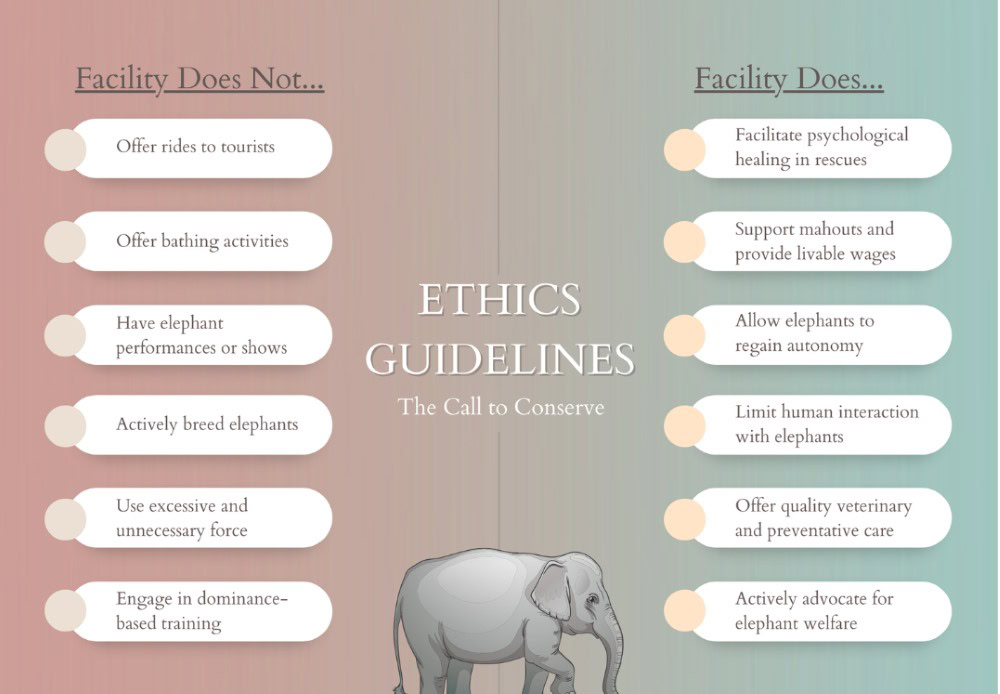
One of the biggest things to remember is this: just because a place says it’s ethical doesn’t mean it is.
True sanctuaries don’t rely on photo ops, direct contact or staged behaviours.
Instead, they focus on giving elephants space to live freely and giving visitors the chance to observe and learn, not interfere.
We’ll link further down to some helpful resources, including Call to Conserve, which keeps an updated list of verified ethical sanctuaries across Thailand. But for now, just knowing what to look for is a powerful first step.

The Role of the Mahout
Meaning of Mahout : (in South and SE Asia) a person who works with, rides and tends an elephant.
One of the most misunderstood aspects of ethical elephant tourism is the role of the mahout, the elephant’s caretaker. At first glance, it might feel a bit contradictory.
If it’s a sanctuary, why do the elephants still need someone managing them?
But here’s the reality: once an elephant has lived in captivity, it usually can’t survive alone.

Many rescued elephants in Thailand come from the logging or tourism industries. They’ve spent years being controlled by humans and sadly, they’ve lost the skills they’d need to survive in the wild.
On top of that, there’s not enough protected land in Thailand to safely release them, so without some guidance, elephants could wander into farmland or villages, causing unintentional damage and creating conflict with local communities.
That’s where the mahout comes in.

In an ethical elephant sanctuary, the role of the mahout is all about protection and support, not control. Ideally, it’s one mahout per elephant, forming a strong, respectful bond over time.
A good mahout is there to:
- Monitor the elephant’s health and behaviour and check for wounds every day
- Administer any necessary medical care, often sanctuary elephants are elderly and need additional supplements and medicines to keep them healthy
- Keep the elephant safe and within the sanctuary boundaries
- Provide gentle, quiet guidance, only when needed
It’s a demanding role, physically and emotionally and one that’s deeply rooted in Thai culture. While it’s true that unethical training methods still exist in some places, a healthy mahout-elephant relationship is built on respect, not dominance.
Ethical sanctuaries invest in their mahouts, offering training, fair wages and support. In the best cases, this partnership helps the elephant live a more natural, peaceful life, with minimal interference and maximum dignity.
So no, the presence of a mahout isn’t a red flag. In fact, in the right environment, it’s part of what makes a sanctuary truly ethical.

Why It’s So Hard to Tell if an elephant Sanctuary is Ethical
In recent years, “sanctuary” tourism has exploded in popularity across Thailand and while that sounds like a step in the right direction, it’s not always good news.
As more travellers seek out ethical experiences (which is amazing), more businesses have realised there’s money to be made in looking ethical, even if they’re not doing anything differently behind the scenes.
This is where ethics-washing comes in.👇
When places use buzzwords like sanctuary, rescue, eco-friendly, or no riding to make you feel good about booking, without actually changing how the elephants are treated or being honest about how the activities truly impact the elephants.
It’s all part of a clever marketing strategy and it works because it taps into the exact thing most of us want: to do the right thing.
But here’s the problem, even well-meaning travellers can end up supporting exploitative practices simply because the messaging is so convincing and there’s no understanding of what an ethical sanctuary really looks like.
A place might claim to be ethical, show lush jungle scenery and post “happy” elephants on social media, but still offer feeding, touching, bathing, or have the animals under control for the benefit of tourists.

The line between ethical and unethical has become blurred and that’s what makes it so confusing.
And yet, this is why our choices matter so much.
Every time we book a ticket, leave a review, or share a photo, we’re helping shape what kind of elephant tourism gets supported and what fades out.
Riding became less common because travellers stopped booking it. The same can happen with bathing and other hands-on experiences if we continue to ask more questions and make more conscious decisions.
You don’t have to be perfect, just informed. And the more we learn, the more we can shift the industry in the right direction.

What does hands-off actually mean?
You’ll hear the phrase hands-off used a lot when talking about ethical elephant experiences, but what does that actually mean in practice?
In short, it means letting elephants be elephants, without human interference.
That includes no touching, no feeding, no bathing and definitely no riding.
It’s about giving them space to roam, socialise, forage and behave naturally, rather than shaping their day around tourist interaction.
Now, we get it, the idea of getting up close and personal with elephants is appealing.
Bathing them, giving them a snack, or even just snapping that perfect selfie sounds magical. And for years, that kind of close contact was sold as the “ethical” alternative to riding.
But here’s the uncomfortable truth: even without a saddle, those experiences still rely on the elephant behaving a certain way, at a certain time, for human benefit.
That often means training, control and stress, even if you don’t see it happening. Elephants may appear calm and compliant, but that doesn’t mean they’re comfortable.

Hands-off doesn’t mean distant or disengaged. In fact, some of the most meaningful moments come from simply observing elephants living freely, watching them wander through the forest, interact with each other, or splash in the mud on their own terms.
It’s slower, quieter and you won’t get those close up Instagram selfies but it’s more respectful and far more rewarding. We have banked some amazing photographs of elephants at both Somboon and Chang Chill, which you’ll see in this post and all were taken from a respectful distance without interfering with the elephants.
I’ll never forget the first time we spotted an elephant at Chang Chill on our forest walk or the moments we spent watching and photographing the eles grazing on bamboo at sunrise at Somboon Legacy Foundation. These moments can never be replaced by a forced photo opp.
In a truly ethical sanctuary, your presence doesn’t change the elephant’s behaviour. And that’s exactly how it should be.

Is Elephant Bathing Ethical?
No, elephant bathing is not ethical.
Elephant bathing is often marketed as a kind, hands-on alternative to riding, something that feels gentler, more natural and even bonding. You’re not on their back, after all. You’re just in the water with them, splashing around. What’s the harm?
Here’s the thing: it’s not as harmless as it looks.
While bathing might feel ethical, it still involves controlling the elephant’s behaviour, usually on a daily schedule, to suit tourist expectations. And that removes their freedom of choice, which is the opposite of what a sanctuary should be.
Here’s why elephant bathing is not ethical:👇
❌ It removes their freedom – Bathing becomes part of a fixed daily routine, meaning elephants don’t get to choose when or if they bathe.
❌ It interferes with natural behaviour – In the wild, elephants bathe when they want to, often followed by dust bathing, which acts as a natural sunscreen and insect repellent.
❌ It disrupts herd dynamics – Bathing is an important social activity for elephants. Having humans involved interrupts how they bond and interact with one another.
❌ It can cause skin damage – Repeated bathing without follow-up dusting can harm their skin and increase the risk of disease.
❌ It relies on control – Even if it seems gentle, bathing still requires the elephant to follow commands, something that usually stems from early-life training.
❌ It’s unnatural – We wouldn’t pay to wash a dog every day and we certainly wouldn’t bathe a rhino or a tiger. Elephants are wild animals, even in captivity. Close contact with humans in this way is stressful for elephants.
❌ “Calm” doesn’t mean “happy” – Many elephants have undergone harsh training and may appear compliant, not because they’re enjoying it, but because they’ve learned not to resist.

And yes, we often hear, “If the elephant didn’t want to, wouldn’t it just leave?”
But it’s not that simple.
Most elephants used in tourism were trained from a young age to obey. We’ll get into the darker side of that training later in this post, but for now, it’s important to recognise that obedience is often the result of fear, not willingness.
Regardless of whether they’re taken from the wild or born in captivity, elephants used for close tourist interactions like bathing have typically been subjected to a deeply distressing training process known as the ‘crush’.
This brutal method involves tearing young calves away from their mothers, isolating them, withholding food and water and often subjecting them to repeated beatings until their spirit is broken and they respond out of fear.
In a truly ethical elephant sanctuary in Thailand, bathing won’t be offered at all.
But you might be lucky enough to witness something even more special: elephants choosing to splash around or cool off in water, completely on their own terms.
And just to be clear, this isn’t about guilt or judgment. I did this myself, over ten years ago, at a time when elephant bathing was considered the “ethical” alternative to riding. I believed I was making a responsible choice.
But the more we learn, the better we can do and that’s exactly what this guide is here for.

Is Feeding or Touching Elephants Ethical?
Feeding or touching an elephant might seem like a gentle, positive way to connect with them, especially if there’s no riding or bathing involved.
But unfortunately, even these smaller interactions can have a big negative impact on elephant welfare.
Let’s start with feeding. In the wild, elephants spend most of their day foraging, selecting and grazing on a wide variety of plants, grasses, bark and roots to meet their nutritional needs. But in many tourist settings, visitors are encouraged to hand-feed elephants bananas, sugarcane, or other snack-like foods, sometimes over and over again.
Not only is this a poor substitute for their natural diet, it also reinforces the elephant’s reliance on people for food. Over time, this can disrupt natural behaviours, making it harder for elephants to reconnect with the instincts they’ve lost in captivity, especially if they’re part of a rehabilitation or retirement programme.

Touching might seem even more innocent, but elephants are wild animals, even in captivity.
Being patted, stroked or approached by strangers can cause stress, especially for elephants who’ve endured traumatic pasts. Sadly, many have been through harsh training or spent years in industries like logging or street begging. Constant close contact can easily trigger anxiety and undermine their well-being.
And it’s not just about protecting the elephants; there are very real risks to people, too.
According to World Animal Protection, more people are seriously injured or killed by elephants than any other captive animal. This isn’t because elephants are aggressive, but because of their sheer size and unpredictability. Even a playful nudge or shift in position can result in serious injury.

Here’s why feeding and touching elephants should be avoided:👇
- It disrupts natural behaviours – In the wild, elephants forage for their own food. Hand-feeding encourages dependency and reduces their ability to live naturally.
- It adds stress – Physical contact, even gentle or well-meaning, can be distressing, especially for elephants with traumatic histories.
- It prevents recovery – Relying on people for food makes it harder for rescued elephants to reconnect with their instincts.
- It can be dangerous for humans – Elephants may lash out unexpectedly or unintentionally injure someone due to their size.
- They’re not domesticated – Even elephants raised in captivity are still wild. They haven’t been bred over generations for tameness like dogs or horses.
- It poses health risks – At least 12 diseases are known to be transmissible between elephants and humans.

There have been heartbreaking incidents where elephants have lashed out and injured or killed people, often due to past trauma, confusion, or stress. It’s a reminder that no matter how calm or gentle they may appear, they are still wild animals.
And they deserve to be treated with the same caution and respect we’d give any wild creature.
In a truly ethical elephant sanctuary in Thailand, feeding and touching won’t be part of the experience and that’s a good thing.
Observing elephants from a respectful distance allows you to witness their natural behaviours, without interrupting them and honestly, it’s far more rewarding than any close-up selfie.

Elephant Training: The Dark reality behind elephant tourism
It’s one of the hardest truths to learn about elephant tourism, but also one of the most important.
The reason elephants so often “cooperate” with riding, bathing, feeding, or tricks isn’t because they want to. It’s because they’ve been trained to.
And that training is almost always based on fear and control.
The process is known as “the crush”, a brutal method used to break an elephant’s spirit and force them to become submissive to humans.
Here’s what that looks like:
- Baby elephants are taken from their mothers, often within their first year, causing deep trauma for both mother and calf
- Once separated, the young elephant is confined in a small pen or tied tightly with ropes so it can’t move
- They’re subjected to physical punishment including beatings, bullhooks and sleep or food deprivation
- The goal is to condition the elephant to obey commands, even when it’s frightened, stressed, or in pain
It’s not just babies, either. Adult elephants taken from the wild may also go through this process in order to prepare them for the demands of tourism.
This kind of training creates compliant elephants that will participate in tourist activities, such as performing, bathing, working to a schedule, riding and coming into close contact with humans without reacting.
And here’s the uncomfortable part: many so-called sanctuaries will insist that their elephants were never subjected to this kind of training.
They’ll say their elephants were “rescued,” that they’re “happy,” or that they’re there voluntarily.

But in nearly every case, if an elephant is calmly allowing humans to touch, feed, or bathe them, it’s because they were trained to.
This is ethics-washing, plain and simple.
Elephants are wild animals. They are not naturally drawn to people and they do not choose to engage in close contact with humans unless they’ve been conditioned to do so. Captivity doesn’t make them tame, it just makes them compliant. And that compliance comes at a cost.
It’s estimated that around 75% of captive elephants used for tourism in Asia were taken from the wild. And while capturing wild elephants is now illegal in many countries, the practice still continues in some regions due to ongoing demand, especially from tourism. These elephants aren’t domesticated. They’ve simply been forced to comply. Wild animals can be broken into submission, but they will never truly be tame.
We’ll never forget the first time we saw a video of the crush process. It was honestly one of the most heartbreaking things we’ve ever watched.
It changes everything you think you know about elephants, tourism and ethics. But it’s also the truth and knowing it is the first step in making better choices.

Improve Your Photos!
✨ FREE 11 Simple Tips To Elevate Your Travel Photos ✨
Simple, practical tips to take better travel photos – whether you’re using a camera or your phone!
👉 No confusing camera speak, no settings to mess around with, just easy tips you can use straight away 👈
Red Flags to Watch Out For
With so many elephant sanctuaries in Thailand calling themselves “ethical,” it can be hard to know which are genuinaly ethical and which are not.
But once you know what to look for, it gets easier to separate the genuinely ethical places from the ones that just sound good.
Here are some of the most common red flags to watch out for:
🚩 Riding – Still offered in some places, even if it’s described as “gentle” or “bareback.” If riding is available, it’s not ethical.
🚩 Bathing experiences – If tourists are getting into the water with elephants, that’s not a natural or respectful environment for the animals.
🚩 Touching or feeding – If the experience includes physical contact, it’s not hands-off and not in the elephant’s best interest.
🚩 Performances or tricks – Anything that involves elephants doing unnatural behaviours like painting, posing, or playing football is an absolute no.
🚩 Selfies or close-up photos – If their website or social media features tourists standing next to, hugging, or leaning on elephants, that’s a good sign the animals are conditioned to tolerate close contact and that’s not ethical.
🚩 Overly tourist-focused marketing – If the emphasis is on your experience (“walk with elephants,” “get amazing photos”) rather than the elephants’ welfare, be cautious.
🚩 Large crowds – If visitors are allowed to swarm around the elephants or if large groups are present, the animals likely aren’t being given enough space or autonomy.
🚩 Vague or evasive information – Ethical sanctuaries are clear and upfront about their no-contact policy, where the elephants came from and what their daily life looks like. If that info is missing or unclear, dig deeper.
🚩 Breeding programmes – Truly ethical sanctuaries do not breed elephants unless there’s a realistic plan to release them into protected wild spaces, which is extremely rare in Thailand. Breeding in captivity often just creates more elephants for tourism. If you see a baby elephant, ask questions.
🚩 Chains or bullhooks – These are a grey area. If you see chains or a bullhook in a hands-off, observation-only sanctuary, they may be used for safety rather than control. It’s context-dependent. If elephants are being forced to perform, interact or stay in place — and those tools are being used — that’s a red flag.
It’s also worth saying: if you feel unsure, trust your gut.
The most ethical elephant sanctuaries in Thailand won’t just say the right things, they’ll demonstrate them clearly, both in how they talk about their work and in what they don’t allow visitors to do.
And if you have questions, ask. An ethical place will always be open and honest about their practices and if they’re not, that’s all the answer you need.

How to Find a Truly Ethical Elephant Sanctuary in Thailand
So now you know what to avoid — but where do you find the good ones?
The truth is, the most ethical elephant sanctuaries in Thailand often don’t show up on the first page of Google. They’re not always on big booking platforms like Get Your Guide or Viator and they rarely shout the loudest on social media.
Why?
Because they’re not spending huge amounts of money on marketing, they’re focusing their energy on the elephants. And often they don’t make anywhere near as much money as the bigger non-ethical elephants organisations.
The only tour company that we know (and have worked with personally AND trust) that offers ONLY ethical hands-off elephant tours is Seek Sophie, an ethical and responsible tour organisation that only hosts tours thoroughly researched and vetted by the team.
They have genuinely ethical elephant tours on their website here (Chang Chill included).

Here’s how to find places that are genuinely putting the animals first:👇
- Start with trusted resources – Websites like Call to Conserve, maintain a list of sanctuaries they’ve vetted for high welfare standards. We ALWAYS use this website.
- Read independent travel blogs – Look for recent, firsthand experiences (from people who aren’t being paid to promote the sanctuary or earn affiliate commission from recommending them). Blogs often give a more honest and detailed account of what the visit was really like.
- Check the sanctuary’s website carefully – Do they mention being hands-off? Do they clearly state no riding, no touching, no bathing? Do they explain where their elephants came from and what their daily life looks like? If the language is vague or tourist-focused, that’s a red flag.
- Look at their social media – Are they showing elephants being hugged, fed or bathed by guests? Or are the elephants just… being elephants, with humans kept at a respectful distance? The images say a lot.
- Ask questions directly – Don’t be afraid to email or message the sanctuary. Ask how their elephants were trained, what their contact policy is and what a typical visitor day looks like. A truly ethical place will answer openly and honestly.
It’s worth remembering that ethical travel often means doing a bit more research, but that effort really pays off. You’ll come away knowing your money supported something positive, rather than contributing to an industry built on trauma.
And if you want a place to start?
We visited Chang Chill in Northern Thailand and Somboon Legacy near Bangkok after hearing amazing things from conservationists we trust (like @danielleforwildlife). They are both fully hands-off, focused on education and observation and genuinely put the elephants first.

Ethical Elephant Sanctuaries in Thailand
This list is taken from The Call to Conserve website, Danielle regularly updates list of ethical elephant sanctuaries across Asia, along with guides and helpful visuals that break down what real welfare looks like.
Northern Thailand
- Chang Chill – Mae Wang District, Chiang Mai
Highly recommended. Fully hands-off, educational and supported by World Animal Protection.
- Kindred Spirit Elephant Sanctuary – Mae Chaem District, Chiang Mai
A community-led sanctuary focused on rewilding and forest freedom. Visitors hike to observe elephants in their natural environment.
- Mahouts Elephant Foundation – Karen Hill Tribe, Chiang Mai
A non-profit focused on ethical, low-impact elephant tourism and community collaboration.
- Isara Elephant Foundation – Karen Hill Tribe, Chiang Mai
Offers immersive, observation-only experiences with a strong welfare ethos.
- Burm and Emily’s Elephant Sanctuary (BEES) – Mae Chaem District, Chiang Mai
A peaceful retirement home for elephants, focused on dignity, freedom and choice.
- Boon Lotts – Sukhothai A compassionate refuge dedicated to the ethical rescue, rehabilitation and care of elephants in a natural, cruelty-free environment.
- Elephant Nature Park – Mae Taeng District, Chiang Mai *
A well-known sanctuary with a good reputation, but some experiences involve close contact so they are not the best option. Opt for observation-only visits.

Central and western thailand
- Somboon Legacy Foundation – Kanchanaburi ( A few hours from Bangkok)
Highly recommended. We volunteered here for a month and were blown away by their dedication to hands-off, welfare-first practices.

Southern Thailand
- Following Giants – Ko Lanta District, Krabi
A rewilding-focused sanctuary allowing elephants to roam the forest with minimal human interference.
- Phuket Elephant Sanctuary – Phuket *
One of the ethical options in the south, but still allows some close-contact activities so they are not the best option. Prioritise their observation-only tours. UPDATE 👉 Phuket Elephant Sanctuary has announced that as of 1st April 2026 they will discontinue feeding interactions which is amazing news and a fantastic step forward. However, until then, prioritise observation only tours.

tips before you book
Before you book an elephant sanctuary visit, even one that seems ethical, take a moment to ask a few key questions.
Sanctuaries that put animal welfare first will always be happy to explain their policies and transparency is a good sign that you’re in safe hands.
Here are some essential questions to ask:👇
❓Do you allow riding, bathing, or feeding?
(Any kind of direct contact — even feeding — shifts the experience away from what’s best for the elephant.)
❓ What does a typical day look like for the elephants?
(Look for freedom, forest time and rest, not a schedule based around tourist interaction.)
❓ Where did your elephants come from?
Also, take a look at their social media and website:👇
🚩 Are there selfies, posed photos, or videos of people touching or standing next to the elephants?
That’s a red flag. Even if the caption says “ethical,” the content speaks volumes.
✅ Are the elephants roaming, foraging, playing in the mud, without a crowd around them?
That’s what you want to see.
✅ Smaller group sizes, education-led tours and a clear no-contact policy are all great signs of a sanctuary that truly puts elephants first.

And if you’re still unsure, we highly recommend checking out @connie.needham on Instagram and @Danielle4wildlife the founder of The call to Conserve.
They both share brilliant, honest content on animal tourism, including some eye-opening reels about elephant sanctuaries and ethics.

How You Can Help Change the Elephant Tourism Industry
We know how it feels. It can be overwhelming and honestly, quite disheartening.
You just want to see elephants. Then suddenly you’re learning about chains, cruel training, and how much harm hides behind words like sanctuary, rescue and ethical.
We’ve been there.
When we spent four months in Thailand, we saw it all. Elephants chained by roadsides, camps offering rides, and heartbreaking scenes dressed up as eco-tourism. Friends and family were sharing elephant bathing selfies while calling us dramatic for speaking out.
But here’s the thing. We’re not powerless. As travellers, we actually have a lot of influence.
Elephant riding has already become less common in Thailand. Why?
Because travellers started saying no. They asked questions, chose better and the industry began to shift.
The same can happen with bathing, feeding, and selfie experiences. But only if we keep pushing for better.
Every time we buy a ticket, leave a review or recommend a place, we’re casting a vote for the kind of tourism we want more of.
Supporting truly ethical sanctuaries doesn’t just mean a kinder experience. It helps create a better future for elephants too.
This is one of the reasons we are so passionate about sharing this message. Because we truly believe that by sharing what we have learnt we can help shape a better future for the eles.
Yes, it takes more research. Yes, it might mean skipping the selfie. But in return, you get something far more meaningful.
You still get incredible photos. The kind taken from afar, as the elephants forage for bamboo, where elephants are free and unbothered by humans.
You get to see them just being elephants. Roaming, foraging, playing, splashing. No pressure. No performance. No pain.
And if you’re here reading this, we reckon you care. So here are four ways you can help make a difference.👇
1. Choose Ethical, No-Touch Sanctuaries – and Spread the Word
Seek out the sanctuaries that truly prioritise elephant wellbeing. These are the places where there’s no riding, no bathing, and no touching. They may not have flashy marketing budgets, so they rely on us to shout about them.
Share your visit on social media, leave a glowing review, tag them in your posts, and tell your friends and family. Your words can help steer others towards the right choices and away from harmful experiences.
2. Amplify the Voices Doing the Work
There are incredible people out there fighting for elephants, and your support really does matter. Even something as simple as a like, share or comment can help their content reach more people and raise more awareness.
3. Don’t Feed the Algorithm with Harmful Content
We get it, it’s tough. Watching people cuddle, ride, or bathe elephants can be infuriating, and the urge to comment is real. But here’s the thing: interacting with those posts, even to call them out, only boosts their reach.
Instead, report them (especially on Instagram), then scroll on by. Save your energy for the good stuff, the posts that educate, inspire, and drive change.
4. Speak Up – Even When It’s Uncomfortable
It’s not always easy. Sometimes it feels awkward or like you’re the only one saying something. But it matters. So many people simply don’t know the truth about elephant riding or bathing – we didn’t, once upon a time either.
But since we started speaking up, we’ve had message after message from people saying things like, “I genuinely had no idea – thank you.”
That’s the power of using your voice. You might be the reason someone makes a more compassionate choice. And that’s something to be proud of.

Resources to learn more
If you want to keep learning about elephant welfare, responsible tourism, or how to travel more consciously, here are a few great places to start:
Websites
Call to Conserve – The founder Danielle4wildlife is a wonderful human doing some amazing work to support elephants around the world. A fantastic resource with an up-to-date list of verified ethical elephant sanctuaries across Thailand
World Animal Protection – Reports, campaigns and advice on wildlife-friendly travel
Sustainable Travel International – Excellent information on ethics-washing and elephant-friendly tourism
Project Wild – Founded by our good friend Connie Needham – Project Wild is a platform dedicated to making wildlife education accessible to all, offering ethical wildlife experiences and supporting global conservation efforts through free resources and a directory of responsible projects.
Social media accounts to follow
Here are some amazing accounts to follow that support wildlife conversation:
👉 wildtesa

Our Responsibility as Travel Photographers – why we’re talking about this
Yes, this is a travel and photography blog …but wildlife and nature are such a huge part of travel, aren’t they?
If you follow us on Instagram, you’ll already know how deeply passionate we are about protecting wildlife, whether we’re talking about elephant tourism, the ethics of animal encounters, or why feeding monkeys (something we regretfully did ourselves before we knew better) causes more harm than good.
The truth is, once you know better, you have to do better.
As travellers and especially as travel photographers, we feel a huge responsibility to speak up. We’re exploring this beautiful planet, documenting it through our lenses, and sharing it with others. So we believe it’s our duty to help preserve it too.
We’ve seen it too many times: people getting way too close to animals just to get that shot, using food to lure them in, or disturbing habitats for a photo. And while we understand the desire, the excitement, the moment, we also know that no photo is worth compromising an animal’s wellbeing.
Ethical travel and ethical photography are at the core of who we are. We want to give more than we take as we move through the world. That means respecting wildlife, supporting responsible tourism, and encouraging others to do the same.
We’ll always speak up about these issues, here on the blog, on social media, and in our conversations, because we genuinely believe that education and awareness can lead to real change.
And more than anything, we want you to have those incredible, once-in-a-lifetime experiences without causing harm, experiences that are not only breathtaking but also respectful, kind, and lasting in all the right ways.
Final thoughts
Visiting an ethical elephant sanctuary in Thailand can be one of the most rewarding experiences of your trip …….when it’s done right.
It’s not just about saying no to riding anymore, it’s about stepping away from all forms of hands-on tourism and giving elephants the space and dignity they deserve.
And while elephant sanctuaries often top the list of things to do in Thailand (especially up north), it’s worth remembering that there’s so much more to this incredible country than just one experience.
Chiang Mai and the surrounding region are absolutely bursting with lush landscapes, hill tribe villages and quiet corners that are perfect for photography and slow travel.
And down in Bangkok? You’ve got unique temples, chaotic markets and hidden photo spots around every corner.
So if you’re planning your trip and wondering what else to see and do, don’t stop here! Whether you’re into sunrise views, vibrant street life, or peaceful cultural gems, we’ve got you covered.
➡️ Explore Doi Inthanon National Park from Chiang Mai
➡️ Explore Bangkok’s hidden temples

More Thailand Inspiration!
- Visiting Phu Chi Fa Mountains in Thailand – A Photographers Guide
- 2-Week Northern Thailand Itinerary for Photographers
- How to get from Chiang Mai to Doi Inthanon National Park
- Guide to Ang Ka Nature Trail in Doi Inthanon National Park
- Pha Dok Siew Nature Trail – Doi Inthanon National Park
- How to choose an ethical elephant sanctuary in Thailand
- Kew Mae Pan Nature Trail in Doi Inthanon National Park
- Mae Ya Waterfall in Doi Inthanon National Park – A Photographers Guide
- Mae Klang Waterfall in Doi Inthanon National Park – A Complete Guide
- Mae Salong in North Thailand – A 2-Day Itinerary
- Things to do in Doi Inthanon – A Day trip from Chiang Mai
- The Overnight Sleeper Train from Bangkok to Chiang Mai
- How to Visit Thailand’s Sky Temple in Lampang
- How to Travel from Chiang Mai to Bangkok by Day Train
- Ultimate Guide to Wat Sam Phran Dragon Temple in Bangkok
- Visitors Guide To Sirithan Waterfall in Doi Inthanon
- Wachirathan Waterfall in Doi Inthanon – A Complete Guide
- 4 Beautiful Doi Inthanon waterfalls You Shouldn’t Miss
- A Complete Guide to 3 Beautiful Doi Inthanon Hikes
- A Complete Guide to Twin Royal Pagodas at Doi Inthanon
- Chang Chill – An Ethical Elephant Sanctuary in Chiang Mai
- Is It Safe to Drive in Thailand? Everything You Need to Know
- Chiang Mai Lantern Festival: Is it Worth it? An Honest Guide
- 11 Best Places to Visit in Northern Thailand for Photography
- 4 Day Chiang Mai Itinerary for Photographers
- Guide to The Tiger Cave Temple in Kanchanaburi – Wat Tham Sua
- The Photographer’s Guide to Erawan Waterfalls, Kanchanaburi
