
How to travel by train to Kanchanaburi from Bangkok
InWanderment contains affiliate links. If you make a purchase or a booking using these links, we may receive a commission at no extra cost to you. This helps with the cost of running InWanderment. See our Privacy Policy page for more information. We appreciate your support!
Thinking of getting the train to Kanchanaburi from Bangkok?
Honestly, we say go for it.
It’ll be one of those slow, scenic travel days that feels like part of the adventure and, in our opinion, is the very best way to get from Bangkok to Kanchanaburi.
It’s affordable, way more environmentally friendly than getting a bus or a private car and gives you a proper glimpse of rural Thailand as you trundle through rice fields, tiny villages and palm-lined tracks.
If you’re looking for authentic travel experiences in Thailand, then you’ll love this train ride.
It’s not fancy and you’ll be swapping air con for fans and maybe sharing a bench with a local on their commute but that’s what makes it so good.
And if you’re panicking because you can’t book it online, don’t.
We’ve been there too (honestly, anything you can’t pre-book gives me palpitations), but this is one of those journeys where you can just show up on the day and hop on.
We’ve done a fair share of train journeys during our four months of travel in Thailand and this one, was one of the most relaxed and enjoyable trips!
In this guide, we’ll talk you through everything you need to know and exactly how to get to Kanchanaburi from Bangkok by train.
Where the train leaves from, how to get your ticket, what to expect on the journey and what you can find on board.

📌 Quick Summary
| Detail | Info |
| Departure station | Thon Buri Railway Station, Bangkok |
| Train times | 07:45 (No. 257) & 13:55 (No. 259) |
| Travel time | Approx. 2½ to 2¾ hours |
| One-way cost | ฿100 (fixed price for foreign travellers) |
| Class | 3rd Class Fan (no AC, wooden bench seating) |
| Ticket purchase | Buy at the station on the same day |
| Return trains | 07:05 (No. 260) & 14:43 (No. 258) |
💡 Planning a trip but not sure where to start? 🤔
👉 Grab your FREE Guide to 50+ of the BEST travel apps – Apps to help you navigate, find volunteer roles, house swapping, transport, planning, and more!
✈️ As full-time travel photographers, we’ve personally tested and used every app in this guide during our 18 months on the road, and they honestly made travel smoother, smarter, and way more fun.
📩Pop in your email and we’ll send it straight over – hope it helps make your next adventure a little easier!
Why take the train from Bangkok to Kanchanaburi?
If you’ve read our other blogs, you’ll know that we love a train journey. And Thailand has some really scenic and cool train routes to experience.
And this was no exception.
Not just because it’s scenic (although it really is), but because it actually felt like travel, not just transport.
As travel photographers who like to take things slow, the train to Kanchanaburi from Bangkok gave us that sense of adventure that buses and vans just don’t.
It was chilled, full of local travellers rather than tourists and the pace meant you could actually look out the window and enjoy it, not just scroll your phone until you arrived.
Sure, it was a bit warm because there’s no air con, just ceiling fans and open windows, but honestly, that breeze, the clack of the tracks and the views across rice fields and villages made it feel really peaceful.
It’s also super affordable, less hassle than tours and way more relaxed than driving yourself from Bangkok.
If you’re after a relaxed, authentic way to start your time in Kanchanaburi, we’d pick this every time.

Which Station in Bangkok Goes to Kanchanaburi?
Where to Find Thonburi Train Station
Unlike most routes in Thailand, the train to Kanchanaburi from Bangkok doesn’t leave from the well-known Hua Lamphong or Bang Sue stations.
Instead, you’ll need to make your way to Thonburi Railway Station, which is a smaller, more local station on the west side of the river.
It’s the only station in Bangkok that runs this particular route, so definitely double-check you’re heading to the right place.


How to Get To Thon Buri station
To get from central Bangkok to Thon Buri station, you have a few options: Grab, (Asia’s version of Uber), normal taxi or boat + walk
We took a Grab, which was quick and easy, but Bangkok traffic can catch you out, especially during the morning rush.
To play it safe, aim to get there at least an hour early. That gives you time to grab a ticket and enjoy a slow start with an iced coffee from the little stall across the road (highly recommend).

If you’re feeling more adventurous, you could also take a river boat to Wang Lang Pier, then walk from there, it’s about 10–15 minutes on foot. But honestly, if you have bags with you, just save yourself the messing around and get a grab.
Below you can see a map of where to find Thon Buri station (marked with a blue train emoji) in relation to the well-known Kha San road (marked with a red star).👇

What is the cost for the Train to Kanchanaburi from Bangkok?
The train fare is fixed at ฿100 per person for foreign travellers, no matter which train you take. That’s around £2 or $3 and for a 2.5-hour journey through some really scenic parts of Thailand, it’s an absolute bargain.
There’s only 3rd class on this route, which means simple bench seating and fans instead of air con, but the windows stay open and the breeze does a decent job of keeping things comfortable, especially in the morning.


How to buy tickets for the Bangkok to Kanchanaburi train
You don’t need to book in advance for the Thonburi to Kanchanaburi train and actually, you can’t book online for this route.
Just turn up on the day and get your ticket from the counter at Thonburi station.
We get it, if you’re a planner (same), the idea of not having a ticket ahead of time might feel a bit stressful.
But honestly, this route rarely sells out and the system is really relaxed. We arrived about an hour early, bought tickets on the spot and there were still plenty of seats available when we got on the train.

Departure Times and Journey Duration
There are two daily trains that run from Bangkok’s Thonburi Station to Kanchanaburi, so you’ve got a bit of flexibility depending on how early you want to get going.
👉The morning train (No. 257) leaves at 07:45 and arrives at 10.20am, which we think is the better option if you want to make the most of your day.
👉The afternoon train (No. 259) departs at 13:55 and arrives at 16.19pm, perfect if you’re not a morning person or just taking things slow.
| Train | Leaves Bangkok | Arrives in Kanchanaburi |
| 257 | 07.45 | 10.20 |
| 259 | 13.55 | 16.19 |


Which is the best train to kanchanaburi from Bangkok?
In our opinion, the morning train is the best option because it’s cooler.
With no air conditioning, you’ll want to travel during the coolest part of the day, plus you have the whole day ahead of you in Kanchanaburi once you arrive.

How long does the train journey take from Bangkok to Kanchanaburi?
The journey takes around 2.5 hours, depending on stops and how the day is running.
It’s not a high-speed train, so sit back, enjoy the scenery and don’t expect to rush. We actually found the journey really relaxing and it was a window in a pretty hectic travel schedule where we could just sit back and chill.

What Is the Train to Kanchanaburi Like?
Inside the Train
It’s definitely not luxury but that’s kind of the charm.
All the carriages are fan only (no air con), with bench-style plastic seats and open windows that you can slide right down.

There’s no luggage compartment either, so we just popped our big bags on the seat next to us and shoved our daypacks on the little overhead rack. It’s simple and a bit creaky, but it does the job and only makes it feel more authentic.
We’d really recommend getting the morning train if you can.
It’s cooler, the light’s softer and with the windows open, it actually feels pretty breezy and comfortable. By afternoon, you’ll be melting and sticking to the plastic seats! Especially if you travel around April, when we did. (not the best idea as it’s the hottest month!).
Seats aren’t reserved, so just hop on and grab wherever’s free.

Facilities on the Train
🪭There’s no air con, but the ceiling fans do their best and with the windows wide open, there’s usually a decent breeze – especially on the morning train.
🍅 You won’t find a restaurant carriage or anything fancy, but vendors hop on at various stops selling cold drinks, fruit and snacks. We grabbed a cold bottle of water and some sticky rice and it hit the spot.
🚽There is a toilet, it’s basic but western-style, which is a win. But be sure to bring your own toilet tissue and antibacterial gel.
🧳No luggage holds that we could see, but there’s plenty of space to just put them next to you on the seats.


📸 FREE Guide – 11 Simple Tips To Elevate Your Travel Photos
✅ Designed to help anyone take better travel photos, with no technical jargon, no confusing settings, and no need for fancy gear.
🎉 Simple, practical tips to take better photos – whether you’re using a camera or your phone!
Photography on the train
Now, if you’re hoping to shoot from the train… It’s a bit hit and miss.
You’re moving fast and trying to get a sharp shot through an open window on a bumpy track? Not always easy. But it’s still worth having your camera handy.
The countryside views are gorgeous in parts, especially the rice fields and little local stations and when you go over the Bridge over the River Kwai, expect loads of people to be waving at you and taking photos of the train.
It was kind of strange but also hilarious as we felt like we were part of the attraction. We ended up waving back and surprising everyone by shouting hello at everyone who stood there!


Tips for Taking the Train to Kanchanaburi
What to Bring and Do Before You Go
✅Toilet tissue – as with most places in Asia, there won’t be toilet tissue so bring your own and pack some hand sanitiser as well
✅Cold drinks and a few snacks – although vendors do come through, it’s good to have something with you
✅ A reusable water bottle – we recommend Water-to-Go filter bottles, as they can be used almost anywhere and filter out viruses and bacteria. Keeping you hydrated and safe and reducing single-use plastics!
✅A good book or playlist – you probably won’t get a signal for most of the journey, so put your phone away and just soak up the views
✅A power bank – there are no plug sockets, so charge up everything the night before

When to Arrive for the Best Seats
There’s no seat reservation, so it’s just a case of jumping on and sitting wherever looks good.
When we travelled, the train was nowhere near full and we had loads of space, but it’s always worth arriving at least 30–45 minutes early just to take the stress out of it and get your pick of the benches.
📅 Tip: Continuing on to Nam Tok and Beyond
If you’re planning to explore more of the Death Railway route, the train doesn’t just stop at Kanchanaburi; it actually continues all the way to Nam Tok. You can ride the full route or hop off at one of the stops along the way, depending on your plans. Just make sure to check timings and return schedules if you’re going further afield.

What to Do in Kanchanaburi After You Arrive
So you’ve made it off the train, stretched your legs and now you’re wondering – what’s next?
Kanchanaburi has loads to offer, especially if you’re into photography, nature and cool temples.
Here are a few of our favourites to add to your Kanchanaburi itinerary.
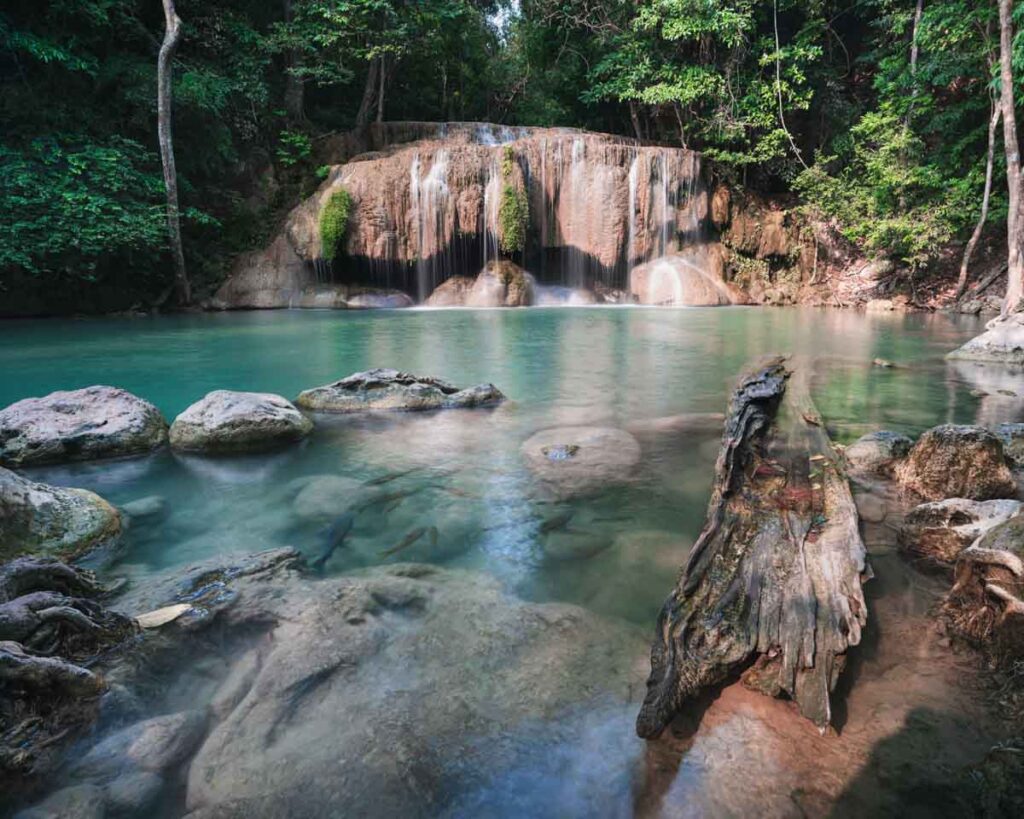
Erawan Waterfalls
These stunning tiered falls in Erawan National Park are a must-see. Arrive early for the softest light and to get nice waterfall photographs without the crowds. The water really is that blue!!
Somboon Legacy Foundation
If you’re after an ethical elephant experience in Kanchanaburi, this is hands-down our top recommendation. There’s no riding, bathing or performances, just peaceful observation and learning about elephant care. It’s also where we volunteered for a month and it’s the only truly ethical elephant sanctuary in the area.

Temples like Wat Tham Sua
This one’s hard to beat if you’re a fan of architecture or drone photography. Perched on a hill with sweeping views over the rice fields, Wat Tham Sua (Tiger Cave Temple) is one of the most unique temples we’ve photographed.

The Death Railway & Bridge Over the River Kwai
A deeply moving site that tells the story of those who suffered building the railway during WWII. If you’re interested in history, it’s one of the most important things to do in Kanchanaburi. Visit early or around golden hour for the best light and a quieter experience.

Wat Baan Tham
A short drive from Wat Tham Sua, is Wat Baan Tham. Another epic temple. To reach the cave, you’ll climb a staircase that feels like you’re walking into the mouth of a dragon!
The temple itself is beautifully set with the mountains behind it and the Mae Klong River in front, making a lovely spot for photography and a bit of peaceful exploring. We didn’t get a chance to go inside, but managed to get a quick drone shot on the way back!

Kanchanaburi Night Market
A laid-back, local market that comes alive in the evening, perfect for grabbing dinner, browsing handmade goods and soaking up some street life. It’s a great addition to your Kanchanaburi itinerary and you’ll even find plenty of vegetarian options and opportunities for street photography!

Taking the Train Back to Bangkok
Once you’re ready to head back to the city, heading back to Bangkok by train is just as easy.
There are two main departures back to the city from Kanchanaburi Railway Station each day:
👉 07:05 – great if you’re heading off early to make the most of your day in Bangkok
👉14:43 – ideal if you fancy a slower morning and a final wander or coffee before you leave

We took the afternoon train and it was super relaxed with plenty of seats, great views and the same laid-back experience we’d had on the way there. The only difference was that it was much, much hotter than the morning train so be warned.
You can buy your return ticket at the station before departure, so just arrive with a bit of time to spare.
Final thoughts on the bangkok to kanchanaburi train
If you’re the kind of traveller who prefers slow, scenic journeys over cramped buses and pre-packaged tours, the train from Bangkok to Kanchanaburi is absolutely worth it.
It’s not fancy, the seats are a little hard, there’s no air con and sometimes the windows rattle. But it’s all part of the charm. You get to sit alongside locals, watch the world roll by and actually enjoy the journey, not just the destination.
It’s perfect for budget travellers, photographers and anyone curious about the real Thailand beyond the highways.
We’d take this train again in a heartbeat.

Where to Go After Kanchanaburi?
Once you’ve wandered through temples, chased waterfalls and soaked up the slower pace of Kanchanaburi, you’ve got a few great options for where to head next, depending on your interests!
Explore more of Bangkok
If you didn’t quite get your fill of Bangkok the first time, heading back can be a nice way to break up the journey. There’s so much to explore beyond the main sights from quirky temples, hidden markets and some gorgeous golden hour spots for city photography that most people completely miss.

Head North to Chiang Mai
This is what we did and we highly recommend it. The overnight sleeper train to Chiang Mai is part of the adventure (plus, you save a night on accommodation).
Once you arrive in Chiang Mai you’ll be spoilt for things to do, from the nearby Doi Inthanon National Park or the cities temples.
Or do what we did, hire a car and head off on a Northern Thailand road trip. An adventure full of misty mountains, quiet villages and some of our all-time favourite photography locations in Thailand.
Wherever you’re off to, Kanchanaburi makes a pretty unforgettable stop and it definitely left us wanting more.

More Thailand Inspiration!
- Visiting Phu Chi Fa Mountains in Thailand – A Photographers Guide
- 2-Week Northern Thailand Itinerary for Photographers
- How to get from Chiang Mai to Doi Inthanon National Park
- Guide to Ang Ka Nature Trail in Doi Inthanon National Park
- Pha Dok Siew Nature Trail – Doi Inthanon National Park
- How to choose an ethical elephant sanctuary in Thailand
- Kew Mae Pan Nature Trail in Doi Inthanon National Park
- Mae Ya Waterfall in Doi Inthanon National Park – A Photographers Guide
- Mae Klang Waterfall in Doi Inthanon National Park – A Complete Guide
- Mae Salong in North Thailand – A 2-Day Itinerary
- Things to do in Doi Inthanon – A Day trip from Chiang Mai
- The Overnight Sleeper Train from Bangkok to Chiang Mai
- How to Visit Thailand’s Sky Temple in Lampang
- How to Travel from Chiang Mai to Bangkok by Day Train
- Ultimate Guide to Wat Sam Phran Dragon Temple in Bangkok
- Visitors Guide To Sirithan Waterfall in Doi Inthanon
- Wachirathan Waterfall in Doi Inthanon – A Complete Guide
- 4 Beautiful Doi Inthanon waterfalls You Shouldn’t Miss
- A Complete Guide to 3 Beautiful Doi Inthanon Hikes
- A Complete Guide to Twin Royal Pagodas at Doi Inthanon
- Chang Chill – An Ethical Elephant Sanctuary in Chiang Mai
- Is It Safe to Drive in Thailand? Everything You Need to Know
- Chiang Mai Lantern Festival: Is it Worth it? An Honest Guide
- 11 Best Places to Visit in Northern Thailand for Photography
- 4 Day Chiang Mai Itinerary for Photographers
- Guide to The Tiger Cave Temple in Kanchanaburi – Wat Tham Sua
- The Photographer’s Guide to Erawan Waterfalls, Kanchanaburi
