
Practical Tips to Elevate Your Photography on a Cloudy Day
InWanderment contains affiliate links. If you make a purchase or a booking using these links, we may receive a commission at no extra cost to you. This helps with the cost of running InWanderment. See our Privacy Policy page for more information. We appreciate your support!
Photography on a cloudy day has a reputation for being less than ideal.
Many people assume that photographs taken on a cloudy day will not look very good.
The lack of light, lack of blue skies and gloomy conditions can make it difficult to produce a vibrant image.
Sure, photography on a cloudy can be challenging and may deliver a different type of image to the one you had in mind.
But is a cloudy day good for taking pictures?
In short, the answer is a resounding YES!
We live in the UK, so our weather is cloudy 95% of the time.
Yet we have managed to capture some stunning images even with minimal light and a moody atmosphere!
In this blog, we will cover:
- How to take photos in cloudy and overcast weather
- What the best settings are for photography on cloudy and overcast days
- Tips and tricks to create more interesting photos on cloudy and overcast days
- Why cloudy days can produce the best work in your portfolio
- How to edit cloudy and overcast day photos
- How to find out what the cloud cover conditions will be on the day of your shoot
To begin, let’s define the often confused definition between a cloudy and overcast day.
An overcast day is anything about 95% cloud cover and a cloudy day can be anything above 50%.
Photography on overcast days is completely different.
The sunlight will be completely blocked by clouds. Whereas on a cloudy day, you will have some sun shining through and this is very important.

Camera Settings – ISO-125, f/5.6, 1/200 sec, 24mm
Why do Photographers prefer cloudy days?
- They say a landscape photographer’s worst enemy is a clear blue sky. Cloud formations can be magnificent and add drama and interest to complement a dramatic landscape. Landscape photography on overcast days often creates beautiful images!
- Midday harsh light can make shooting difficult due to extreme contrasts in light and shadow. The clouds on an overcast day can act as a giant filter for the sunlight, softening the shadows and diffusing the strong sunlight to create a more appealing aesthetic. This can allow you to shoot at midday which usually isn’t possible when the sun is too strong.
- A break in the clouds can sometimes create a pool of light or even better a light ray which are some of the most coveted natural occurrences in cloudy weather photography.

Camera Settings – ISO-400, f/10,1/40 sec, 26mm
📸FREE Photography Guide
Want to take your photography skills to the next level?
Download our FREE photography planning guide! It’s packed with 8 simple location tips to help you capture breathtaking photos, no matter your skill level.
Simply enter your details below, and we’ll send you the guide along with additional tips and tricks to inspire your photography journey. Whether you’re a beginner or looking to refine your craft, this guide will set you up for success.
Download our FREE guide below👇
Camera settings for cloudy day photography
Shooting on Auto Settings
If you’re shooting on auto settings then your camera software will choose the best settings to expose an image.
This can be very helpful if you are unfamiliar with the manual functions of your camera.
Unfortunately, it’s not perfect so most cameras have an exposure compensation function built in.
This will allow you to brighten or darken an image if it’s not looking right on your viewfinder/display screen.

Shooting in Manual Mode
If you’re shooting in manual mode, aperture or shutter priority mode then here are some tips for the best camera settings for cloudy days.
The best ISO cloudy day photography settings
Unfortunately, there is no best ISO setting for cloudy days or overcast photography. But generally, you will be working with less light on an overcast or cloudy day.
For this reason, you will need to crank up your ISO for cloudy days to compensate for the reduced ambient light.
Results can vary from camera to camera but we find that any number less than ISO 1600 will produce an acceptable image (especially now with Denoise AI).

What shutter speed is best for cloudy days?
Generally, your shutter speed will depend on what you are taking a photo of and not the lighting conditions. If you’re shooting still subjects then a tripod will help you slow down the shutter speed without introducing a camera shake into the image.
💡What is shutter speed? Are you confused about the term shutter speed? Don’t panic! We have a simple, easy-to-read guide breaking down everything you need to know to elevate your photos using shutter speed!
Aperture Settings for cloudy day photography
If you are taking handheld photos, you will need to use a wide-open aperture to allow as much light to reach the sensor as possible.
Our lenses are usually F2.8 and on cloudy days we will walk around with our cameras on that setting all day and only change it if there is a specific shot we’re trying to achieve.
💡What is aperture? Not sure what aperture is? Don’t worry! Check out our easy guide with simple explanations and plenty of photo examples to help you understand!

Shooting in RAW
To make it easier for users to get a good photo out of the box, all cameras will come automatically set to take JPEG files.
These files have a built-in edit which will add contrast, saturation etc to the image file that the camera has captured.
The downside is that some of the data the camera captures will be lost in the process which will give limitations to how much the image can be pushed and pulled in the editing process.

Changing the format your camera takes photos in from JPEG to RAW will allow you to capture all of the image data the camera is capable of which gives you much more flexibility when editing.
But the image straight out of the camera can appear flat and unsaturated.
The editing process for cloudy weather photography can be as simple as opening the photo in an editing app and pressing the auto-edit button.
So even as a beginner, don’t be afraid to shoot in RAW.
Most cameras can take photos in JPEG and RAW at the same time so you can get a pre-edited JPEG file as well as a RAW file in case you want to edit it.

iPhone camera settings for cloudy days
Iphones are pretty exceptional at producing correctly exposed images in all lighting conditions.
The iPhone will pre-determine the settings and also use a more advanced editing algorithm to make the best use of the camera it has.
The pro and max models can shoot in RAW which is an unedited image file. Shooting in RAW will give you more flexibility when editing an image.
There are also apps you can download onto your mobile which will give you full control of the camera settings and allow you to adjust the ISO, Shutter and Aperture on your phone camera and follow the tips for camera settings in this blog.

Want to improve your travel photography but not sure where to start?
📸 Join Travel Photography Fast-Track – Personalised 1-on-1 coaching to take your travel photography to the next level!
Not ready for coaching?
✨ Try Photo Feedback+ – Get expert feedback and a step-by-step plan to transform your photos.

Cloudy Day Photography Tips
1. Long-exposure photos on cloudy days
A gloomy day or overcast sky can be brought to life using an ND filter on your lens to create a slow shutter speed.
This means that any stationary object in the photo will remain sharp while moving objects will blur which often creates cool effects that illustrate movement.
Water will become smooth and glassy and the movement of the clouds will form elaborate patterns in the sky.

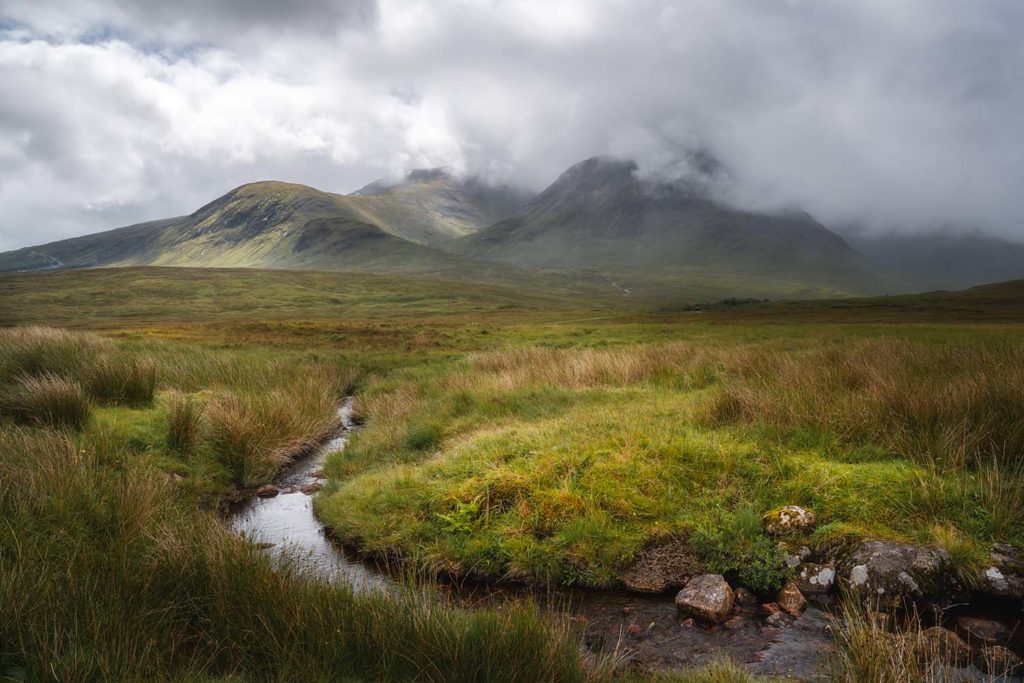
During our landscape photography trip in Scotland, we often faced cloudy and overcast weather. By using long exposures and choosing interesting compositions, we still got some very nice shots of the places we visited.
Generally, for long exposure, you will be dropping the shutter speed down to anything from 0.3 to 30 seconds.
For these exposure times, you will need to use a tripod to keep the camera perfectly still for the duration of the shot.

Camera Settings – ISO 160, f/13, 8-second exposure, 24mm
2. Light Rays and Sun Rays
A break in the clouds can allow fleeting rays of golden light to filter through.
Early morning and late evening are the best time of day to capture light rays due to the light needing to be stronger and creating too much of a disparity between light and dark for your camera to capture.
Light rays can really bring a sense of magic and etherealness to your images.
We absolutely love them and this is one of the reasons we love photography on a cloudy day.

Camera Settings – ISO-100, f/6.3, 1/320 sec, 24mm
📸 FREE Guide – 11 Simple Tips To Elevate Your Travel Photos
✅ Designed to help anyone take better travel photos, with no technical jargon, no confusing settings, and no need for fancy gear.
🎉 Simple, practical tips to take better photos – whether you’re using a camera or your phone!
3. Best lens for photography on a cloudy day
Photography on a cloudy day can be as much about capturing the sky full of clouds as the land beneath it. Using the right lens can make or break your photos.
A wide-angle lens can help you capture the foreground, and midground and include the dramatic sky above.

Camera Settings – ISO-100, f/10, 1/50 sec, 16mm
It can be tricker when it comes to photography on overcast days.
Consider cutting the sky out completely using a telephoto lens and really focusing on your subject.

Camera Settings – ISO-250, f/2.8, 1/500 sec, 180mm
✨ Share your photos in my Travel Photography Facebook group! ✨
4. Include a person in your photo
Cloudy weather photography can be challenging when there is no light. To liven up the scene you can use a person to bring purpose into an image.
A great tip is to try to get your model to wear a contrasting colour to the rest of the environment to make them stand out.

Camera Settings – ISO-640, f/2.8, 1/200 sec, 70mm
5. Light Pools
Light pools are created when the sunlight shines through large gaps in the clouds.
These created dappled patches of light on the landscape that can be particularly stunning in the early morning, highlighting certain areas and darkening others.
It creates stunning soft contrasting patches of light in the early hours and this is why we love photography on a cloudy day the most!

Camera Settings – ISO-100, f/14, 1/160 sec, 45mm
6. Cloud reflections
Another way to make the best of photography on a cloudy day is to find a lake or water feature to reflect the sky.
Llynnau Mymbyr is one of the most beautiful photo spots you can visit in North Wales.
Even though we didn’t get the light we wanted that morning, we got a pretty nice shot of the reflected clouds in the lake.
You can easily create a well-balanced image because the sky will be perfectly reflected in the water.
To create a perfect reflection even on the windiest day use an ND filter to smooth out the water and make it look like a sheet of dark blue glass.

Focus Stacked Image – Camera Settings – ISO-100, f/8, 4 seconds, 35mm
7. Can you get a golden hour on a cloudy day?
You may be thinking that if it’s cloudy then golden hour shots will be practically impossible.
When we visited one of the photography spots on the Isle of Skye, driving there at 5 am in the rain we thought it was all over.
Luckily we caught the sun bursting through a gap in the clouds whilst photographing these mountains which is one of our best landscape shots to date!

Camera Settings – ISO-100, f/16, 1/13 sec, 35mm
If you have chosen to visit a coastal photography spot, then golden hour on a cloudy day can present some amazing photo opportunities.
We like to call it the golden ten minutes, this is the time when the sun has risen and is between the clouds and the horizon.
On days like this, it is very important to plan your shot and get yourself in position while it’s still dark, ready for that brief period, the images you will capture will be some of your best!
💡 Planning a trip but not sure where to start? 🤔
👉 Grab your FREE Guide to 50+ of the BEST travel apps – Apps to help you navigate, find volunteer roles, house swapping, transport, planning, and more!
✈️ As full-time travel photographers, we’ve personally tested and used every app in this guide during our 18 months on the road, and they honestly made travel smoother, smarter, and way more fun.
📩Pop in your email and we’ll send it straight over – hope it helps make your next adventure a little easier!
8. Try monochrome photography on a cloudy day
Although when shooting your camera will capture images in colour, when you come to edit try clicking the Monochrome option in the photo editor.

Black and white photography can allow you to focus more on light contrast, textures and shapes.
It’s also a good method to get reasonable images even when the weather conditions aren’t in your favour.

Camera Settings – ISO-100, f/3.2, 1/640 sec, 50mm
9. Focus on Colour Contrast
Can you still get good outdoor photos on a cloudy day? Of course, you can.
Just remove the cloudy day from the equation!
On a cold grey afternoon, visiting different photo spots in Snowdonia National Park, we stumbled across a beautiful waterfall which was too good not to shoot.
So I got Emma to put on her bright red raincoat and stand in the midground of the scene and we got some really nice waterfall photographs.

Camera Settings – ISO-640, f/8 1/80 sec, 30mm
When there isn’t much contrast in the light then you can either look for or create your own contrasting colours in an image.
If you’ve forgotten your brightly coloured raincoat then fear not. As long as you can find vibrant colours you will still be able to produce something spectacular.
This can be particularly useful in the Autumn when there are colours everywhere.
Would you like to connect with other photographers who share your passion?
✨ Exclusive content on finding beautiful photography locations – how to get there, the best times to visit, and what shots to capture!
✨ Tips, advice and tailored support on photography gear and techniques!
✨ Inside information on the best photo spots in specific locations to help you plan your next trip!
✨ Connecting with other Travel Photography lovers!
10. Waiting for the right moment
Patience is a virtue and this is especially true in regards to cloudy day photography.
We have been in situations where we have seen a spot of light or a break in the clouds in the distance and prayed that it would come our way.
Whether the light comes your way or not is down to chance and as Forest Gump would say,
“Life is like a box of chocolates, you never know what you are going to get”
Photography is all about being in the right place at the right time and a perfect pool of light radiating down on your subject is likely to be one of your best photos of the year.
It’s always worth waiting a little longer.

How to edit cloudy day or overcast day photos?
Adjusting Colours
The same rules apply to editing photos from your mobile or camera.
Just be aware that if you have not shot your images in RAW format, you can only make slight adjustments to the editing sliders in your photo editing app.
Generally with photography on a cloudy day, your photos will come out with a cold hue (who would have thought it?)

Adjusting the temperature slider in your photo editor towards the yellow/warm side will neutralise the colours and take the blue tinge out of the whites.
Going a step further you can use the saturation slider and reduce the blues further to change the sky to the grey colour that your eye sees.
We always reduce the luminance in the blues too, this is an easy way to get some contrast in the clouds.

Sky Replacement
We couldn’t write about cloudy weather photography without mentioning the controversial topic of sky replacement.
This is a feature within adobe photoshop that allows you to use AI to identify and replace the sky in an image.
Landscape photography on overcast days can be pretty boring and even disastrous if you’ve put a lot of effort and money into a photography trip.
There’s nothing worse than driving for hours to a landscape photography spot that you can only realistically visit once only to be faced with a completely lifeless grey sky.

As professional travel photographers, we (and many others) occasionally use sky replacement. Some sky replacements can be more deceptive than others.
We tend to only use similar types of skies to create a more interesting photo rather than applying a dramatic sunset to an overcast day.

How to check the weather and cloud cover before you shoot
Accuweather
We always use the Accuweather website to check cloud cover.
Accuweather gives hourly reports of the cloud cover up to three days in advance. However, we find it best to check again the day before, in case anything has changed.
If you see there is 50% cloud cover and you’re out to shoot the next day then you know that good things are coming your way!
If you see it’s 95% cloud cover then maybe skip sunrise and enjoy a couple extra hours in bed before rocking up around 10 am for the filtered midday light.

Questions about Cloudy Day Photography
Can you take pictures on a cloudy day?
Yes, you can. Cloudy days can present some of the best photographic opportunities.
Do photographers prefer cloudy days?
Yes! If you’re shooting anything with a sky in it then photography on a cloudy day is much more appealing than photography on a clear day.
What to photograph on a cloudy day?
Dramatic landscape shots particularly lend themselves to cloudy days.
However, portrait and street photography do tend to require some light to prevent the images from looking flat and lifeless.
Are cloudy days good for photography?
Photography on a cloudy day when shooting landscapes often creates dramatic and stunning images that are impossible to create in a cloudless sky.
Making use of sun rays, light pools and shadows can create moody images with bags of atmosphere.

Are overcast days good for photography?
Landscape photography on overcast days can be challenging.
One benefit is that at midday there can be enough light coming through the clouds which allows you to shoot at times that otherwise would be impossible.

Final thoughts on Photography on a cloudy day
Photography on a cloudy day can be spectacular. Whether you’ve caught the sun bursting through thick rain clouds in the golden hour (or ten minutes).
Or a momentary break has sent a golden ray of light directly onto the subject of your photo.
You will find that your cloudy day photos are often the most dramatic and who doesn’t love a bit of drama!
Photography on an overcast day will likely be less inspiring. But there is always a chance of a good photo and these days can also be used to practice.
Just remember, if you’ve planned a perfect sunrise shot and the cloud cover is 100% you may want to spend the morning in bed sipping coffee and planning for your next outing instead.
Would you like to connect with other photographers who share your passion?
✨ Exclusive content on finding beautiful photography locations – how to get there, the best times to visit, and what shots to capture!
✨ Tips, advice and tailored support on photography gear and techniques!
✨ Inside information on the best photo spots in specific locations to help you plan your next trip!
✨ Connecting with other Travel Photography lovers!
Tips to elevate your photography
- Mastering What Shutter Speed to Use for Perfect Shots
- Must Have Travel Photography Gear for Your Next Adventure
- How To Find Photography Spots: A Travel Photographers Guide
- When is the Best Time to Take Pictures Outside?
- Best Lens for Travel Photography: What to Pack and Why
- 17 Photography Composition Techniques for Top Travel Photos
- Understanding Aperture: Examples & Photos for Beginners
- Practical Tips to Elevate Your Photography on a Cloudy Day
- 21 Tips for Photographing Mountains
- Ultimate Guide to Perfecting Waterfall Photography
- What is Travel Photography? Start your adventure today!
- 11 Types of Travel Photography Every Traveller Should Explore
- 16 Game-Changing Tips on Travel Photography
- Beginners Guide To Photographing People While Travelling
Beautiful Photography Destinations
- Isle of Skye Photography Guide – 15 Stunning Locations
- 13 Beautiful Places for Landscape Photography in Scotland
- 10 Beautiful Places in North Wales UK for Photography
- Snowdonia Photography – 11 Breathtaking Locations
- How to Spend a Weekend in Cornwall – A 2-Day Itinerary
- Five of The Best Dorset Photography Locations
- Wachirathan Waterfall in Doi Inthanon – A Complete Guide
- How to Visit Thailand’s Sky Temple in Lampang
- Visiting Phu Chi Fa Mountains in Thailand – A Photographers Guide
- Mae Salong in North Thailand – A 2-Day Itinerary
- Mae Ya Waterfall in Doi Inthanon National Park – A Photographers Guide
- Mae Klang Waterfall in Doi Inthanon National Park – A Complete Guide
